

Introduction
Have you ever felt overwhelmed by the demands of your job? Do stress and anxiety creep in every time you step into the office? You're not alone. Many people struggle with workplace anxiety, which can negatively impact productivity, relationships, and overall well-being.
In this article, we'll explore a powerful tool to combat workplace anxiety: cognitive reframing techniques. By rethinking our thoughts and attitudes, we can transform our mental landscape and reduce stress. Let's dive into the world of cognitive reframing and discover how it can benefit you in the workplace.
What is Cognitive Reframing?
Cognitive reframing is a process that involves identifying negative or unhelpful thought patterns and replacing them with more balanced and constructive ones. This technique helps individuals change their perspective on challenging situations, making it easier to cope with stress and anxiety. By reframing our thoughts, we can break the cycle of negative thinking and develop a more positive outlook.

Why is Cognitive Reframing Effective?
Cognitive reframing works because it addresses the root cause of workplace anxiety: distorted thinking patterns. When we're faced with challenging situations, our minds tend to focus on the negative aspects, leading to feelings of overwhelm and anxiety. By identifying these thought patterns and rephrasing them in a more balanced way, we can reduce stress and improve our mental well-being.
How Does Cognitive Reframing Work?
Cognitive reframing is based on the idea that our thoughts, feelings, and behaviors are interconnected. When we experience stress or anxiety, it's often due to our perception of a situation rather than the situation itself. By identifying and challenging these distorted thoughts, we can learn to respond to situations more effectively.
Here are some key features of cognitive reframing:
Identifies negative thought patterns
Challenges assumptions and distortions
Develops alternative, balanced perspectives
Enhances self-awareness and emotional regulation
Understanding the Thought-Emotion-Behavior Cycle
To fully grasp how cognitive reframing works, let's break down the thought-emotion-behavior cycle:
1. Thought: We have a negative or distorted thought pattern. 2. Emotion: This thought triggers an emotional response, such as anxiety or stress. 3. Behavior: Our behavior is influenced by this emotional response, leading to actions that may exacerbate the situation.
By identifying and challenging these thoughts, we can break this cycle and develop more constructive behaviors.
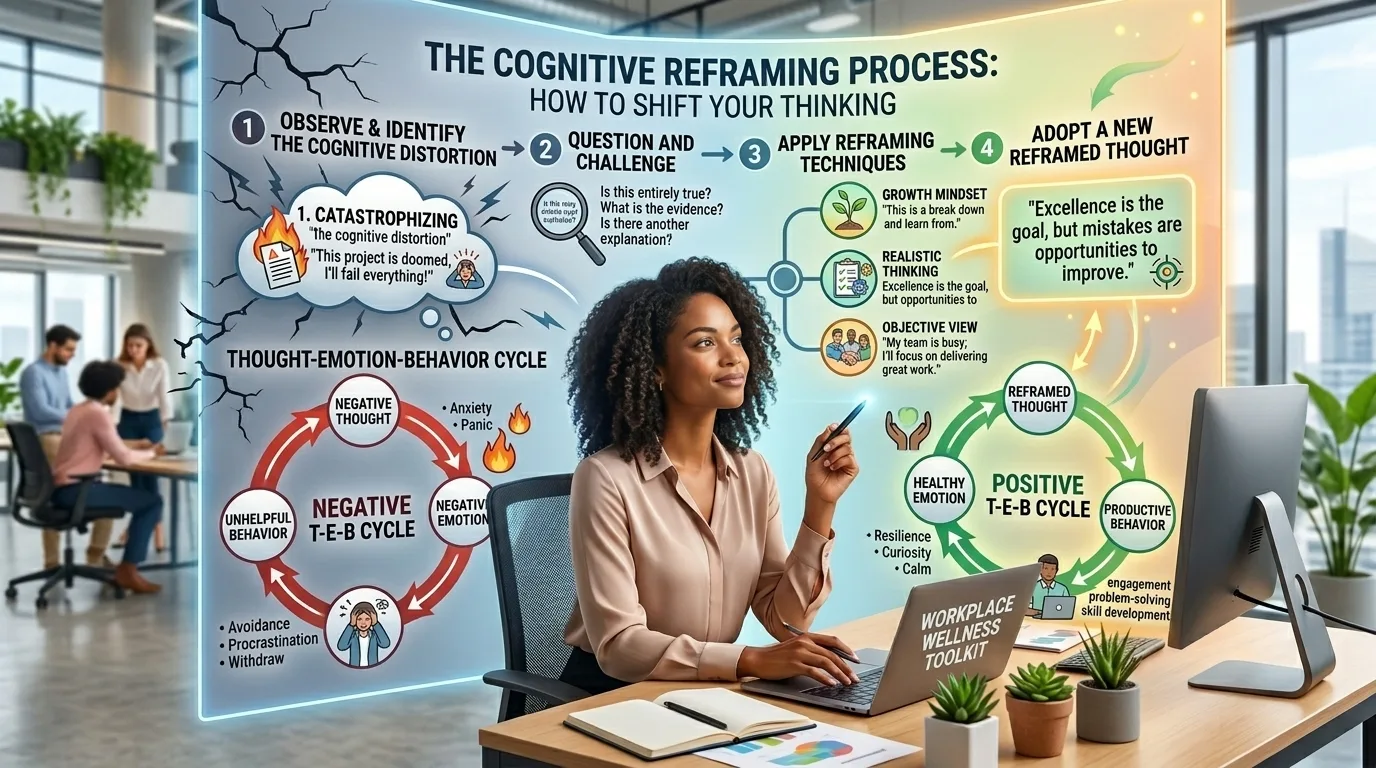
Reframing Workplace Anxiety: Strategies That Work
Now that we've explored the basics of cognitive reframing, let's apply this technique to workplace anxiety. Here are some practical strategies to get you started:
Challenge catastrophic thinking: When faced with a stressful situation, ask yourself if your thoughts are based on reality or distorted by negative assumptions.
Reframe "should" statements: Replace self-criticizing thoughts with more balanced and constructive ones, such as "I'll do my best" instead of "I should have done it perfectly."
Focus on the present moment: Instead of worrying about the future or dwelling on past mistakes, bring your attention to what you can control in the present.
Practice self-compassion: Treat yourself with kindness and understanding, just as you would a close friend.
Creating a Supportive Environment
To fully benefit from cognitive reframing, it's essential to create a supportive environment. This includes:
Identifying positive role models and mentors
Building a network of like-minded individuals who share similar struggles
Prioritizing self-care and stress-reduction activities
Putting Reframing into Practice: Examples and Case Studies
Let's consider an example to illustrate how cognitive reframing works in practice. Meet Sarah, a marketing manager who feels overwhelmed by her workload. She often thinks to herself, "I'm such a failure for not meeting deadlines." By identifying this negative thought pattern, Sarah can challenge it with more balanced perspectives:
Distorted thought: "I'm a failure."
Challenging question: "Is this really true? What evidence do I have?"
Alternative perspective: "I've been working hard and doing my best. Missing a deadline is not the end of the world."
Sarah's reframed thinking helps her regain confidence and motivation, reducing feelings of anxiety and stress.
Developing Emotional Regulation: The Key to Effective Reframing
Emotional regulation is crucial for effective cognitive reframing. By learning to manage our emotions, we can better respond to challenging situations and reduce stress. Here are some tips for developing emotional regulation:
Recognize your emotions: Identify how you're feeling in the moment.
Label your emotions: Acknowledge your emotions without judgment.
Take a step back: Create distance between yourself and the situation.
Practice relaxation techniques: Engage in activities that help you relax, such as meditation or deep breathing.
Conclusion
Cognitive reframing is a powerful tool for managing workplace anxiety. By identifying and challenging distorted thought patterns, we can reduce stress and improve our mental well-being. Remember, cognitive reframing is not about changing external circumstances but rather about changing your internal perspective.
By applying the strategies outlined in this article, you'll be better equipped to manage workplace anxiety and thrive in even the most challenging situations.
Additional Tips for Effective Reframing
Here are some additional tips for effective cognitive reframing:
Practice regularly: Make cognitive reframing a regular part of your daily routine.
Seek support: Share your experiences with others and seek guidance from professionals if needed.
Be patient: Cognitive reframing takes time and practice. Be gentle with yourself as you work through the process.
By incorporating these tips into your daily life, you'll be well on your way to mastering cognitive reframing and reducing workplace anxiety for good.
This Article was made with AI assistance and human editing.