

Migrating from C++ to Rust: A Guide to Ownership and Systems Programming
As a seasoned developer, you're likely no stranger to the world of systems programming. You've probably worked with C++, one of the most widely used languages in this domain. However, as you continue to work on complex projects, you may have encountered issues related to memory management, concurrency, and safety. This is where Rust comes into play – a language that's gaining popularity among developers due to its unique approach to ownership and systems programming.
In this article, we'll delve into the world of Rust and explore how its ownership model differs from C++. We'll discuss the benefits of using Rust for safer systems programming and provide a step-by-step guide on migrating your existing C++ project to Rust. By the end of this article, you'll have a comprehensive understanding of Rust's capabilities and be well-equipped to make an informed decision about whether it's the right choice for your next project.
What is Rust's Ownership Model?
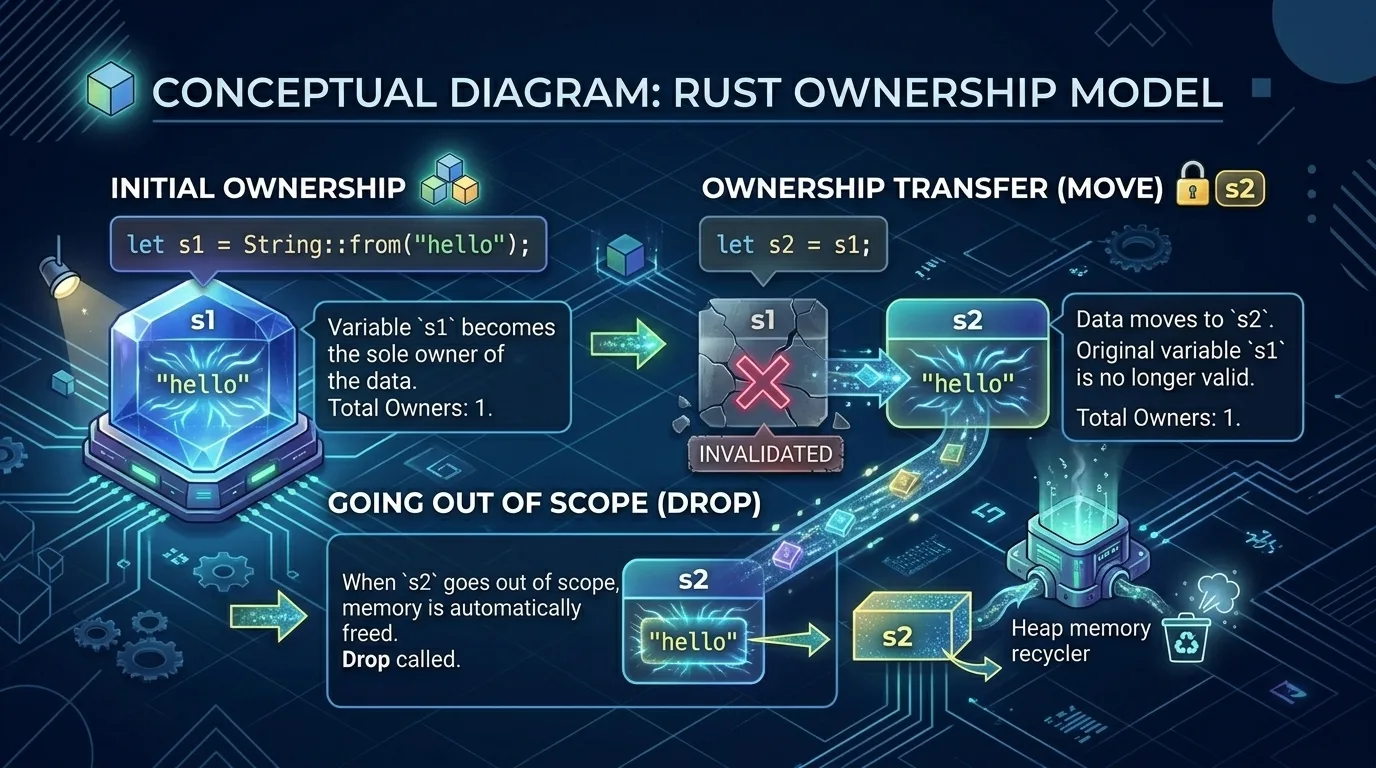
Rust's ownership model is its most distinctive feature, setting it apart from other languages like C++. In simple terms, ownership in Rust refers to the concept of a variable "owning" the data it stores. When a variable owns some data, it means that only one variable can own the same data at any given time. This rule ensures that memory is safely managed and prevents common issues like dangling pointers, null pointer exceptions, and data corruption.
To understand Rust's ownership model, think of variables as containers holding onto their values. Just like how a container can only hold one object at a time, a variable in Rust can only own one value at any given time. This concept is essential to memory safety and prevents common issues that arise from shared ownership or mutable state.
The ownership model in Rust is enforced through several mechanisms:
Variables have a concept of "ownership" which determines how long they hold onto their values.
When a variable goes out of scope (e.g., falls off the stack), it releases its ownership, making the memory available for other variables to use.
The `drop` function is used to explicitly release ownership when necessary.
Here's an example illustrating the concept:
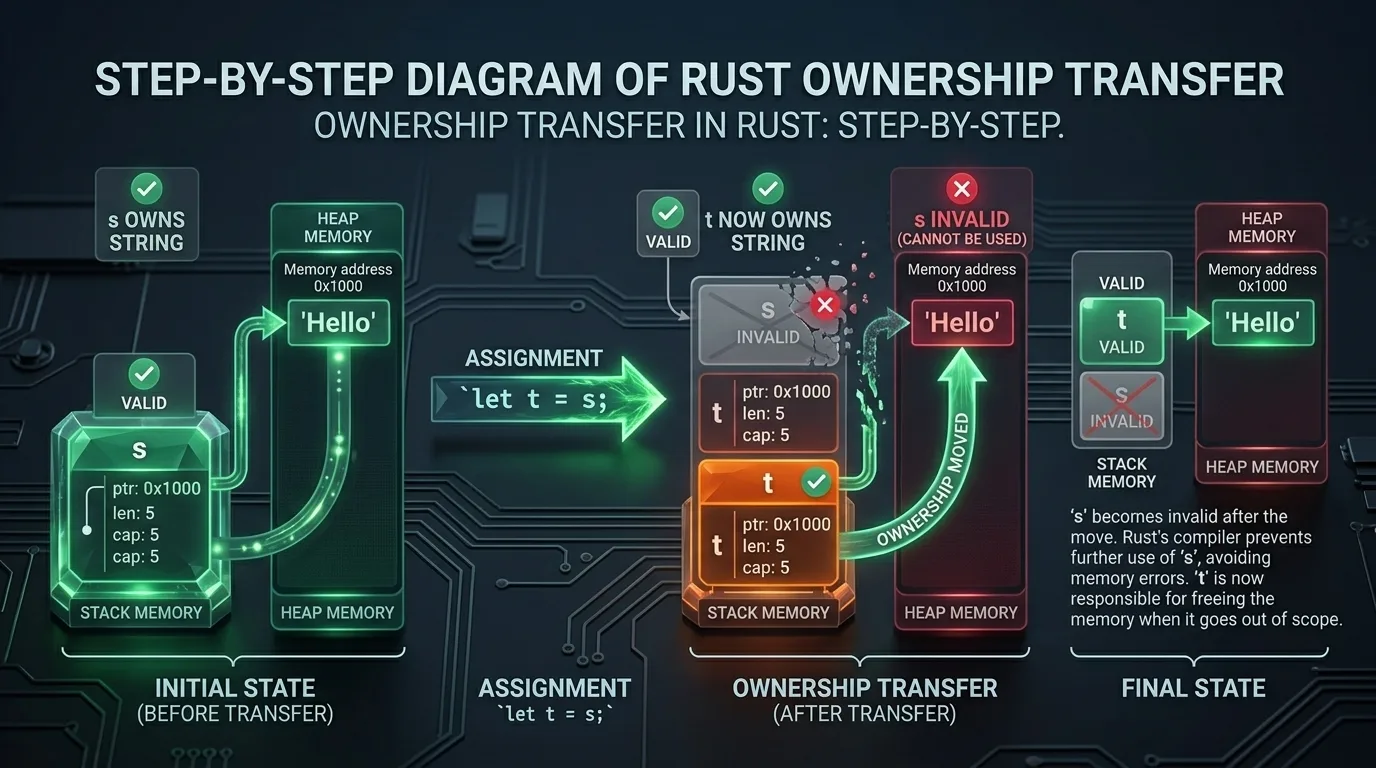
```rust fn main() { let s = String::from("hello"); // s owns a string slice let t = s; // t now owns the string slice, s no longer does } ```
In this example, `s` initially owns the string "hello". When we assign it to `t`, ownership is transferred from `s` to `t`. This illustrates how Rust's ownership model prevents common issues like dangling pointers.
Benefits of Rust's Ownership Model
Rust's ownership model provides several benefits:
Memory Safety: By ensuring that each variable owns the memory it uses, Rust prevents common issues like null pointer exceptions and data corruption.
Prevention of Dangling Pointers: Since variables can't share ownership, dangling pointers are eliminated.
Automatic Memory Management: Variables automatically release their ownership when they go out of scope, eliminating the need for manual memory management.
Here's a list summarizing the benefits:
Eliminates null pointer exceptions and data corruption
Prevents dangling pointers by enforcing exclusive ownership
Automates memory management through variable scope
Migrating to Rust: A Step-by-Step Guide
If you're considering migrating your existing C++ project to Rust, follow these steps:
1. Familiarize yourself with Rust basics: Start by learning the fundamental concepts of Rust programming, such as ownership, borrowing, and lifetimes.
2. Rewrite your code: Begin rewriting your C++ code in Rust, focusing on one module or function at a time. Use online resources, such as the official Rust documentation and tutorials, to help you along the way.
3. Take advantage of Rust's libraries and frameworks: Leverage Rust's extensive ecosystem for easy integration with other libraries and frameworks.
4. Test your code thoroughly: Ensure that your rewritten code meets all the requirements and functionality of the original C++ project.
Additional Resources
For further learning, consider the following resources:
The official Rust documentation: A comprehensive resource covering all aspects of the language.
Rust by Example: A tutorial series that guides you through creating a simple Rust program.
The Rust book: An in-depth guide to building systems programming projects using Rust.
By exploring these resources and adapting your code to Rust's ownership model, you'll be well on your way to creating safer systems programming projects with reduced complexity.
Conclusion
Rust's adoption is gaining momentum among developers due to its ability to ensure memory safety and prevent common issues like dangling pointers. By embracing Rust, you can:
Develop safer systems programs with reduced complexity
Leverage the language's extensive ecosystem for easy integration
Take your next project to the next level by exploring the world of Rust and its ownership model.
Common Challenges When Migrating from C++ to Rust
When migrating from C++ to Rust, you may encounter some challenges. Here are a few:
Understanding ownership: As mentioned earlier, ownership is a fundamental concept in Rust. It may take time for developers to adjust to this new way of thinking about memory management.
Lifetimes and borrowing: Another key concept in Rust, lifetimes ensure that variables remain valid for the duration of their usage. Borrowing allows you to share data between functions without transferring ownership.
Error handling: Rust's strong focus on safety means it has a more comprehensive error-handling mechanism than C++. This can be a significant departure from what developers are used to in C++.
Conclusion
In conclusion, migrating your existing C++ project to Rust requires understanding the language's unique concepts and benefits. By embracing Rust, you'll be able to develop safer systems programming projects with reduced complexity. Don't hesitate to take advantage of the resources available for further learning and exploration.
Additional Resources
For more information on the topics discussed in this article, consider exploring the following resources:
The official Rust documentation: A comprehensive resource covering all aspects of the language.
Rust by Example: A tutorial series that guides you through creating a simple Rust program.
The Rust book: An in-depth guide to building systems programming projects using Rust.
By exploring these resources and adapting your code to Rust's ownership model, you'll be well on your way to creating safer systems programming projects with reduced complexity.
This Article was made with AI assistance and human editing.