

Unlocking Student Potential: The Power of Adaptive Learning Paths
In today's education landscape, personalized learning has become a buzzword. With the rise of EdTech tools and platforms, teachers and educators are now better equipped than ever to tailor their teaching methods to meet the unique needs of each student. Among these innovative solutions is Khan Academy's adaptive learning paths – an evidence-based approach that offers promise for enhancing educational outcomes.
What are Adaptive Learning Paths?

Adaptive learning paths are dynamic, student-centered approaches that utilize real-time data and assessment results to inform instruction. This methodology adapts to individual students' strengths, weaknesses, and learning styles, ensuring a tailored educational experience that can accelerate progress and boost confidence. By leveraging AI-driven algorithms, adaptive learning platforms continuously monitor and adjust the difficulty level of content, activities, and assessments in response to student performance.
To illustrate this concept, consider a math lesson where students are working on solving equations. An adaptive learning platform would analyze each student's responses in real-time, identifying areas where they need extra support or challenge. The platform might then adjust the difficulty level of subsequent questions, providing more complex problems for advanced learners while offering additional support to struggling students.
Adaptive learning paths are often contrasted with traditional teaching methods, which may rely on standardized curricula and instruction that fails to account for individual differences in student learning styles and abilities. By using adaptive learning platforms, teachers can create a more inclusive and supportive learning environment that caters to the diverse needs of their students.
How Does Khan Academy Implement Adaptive Learning?
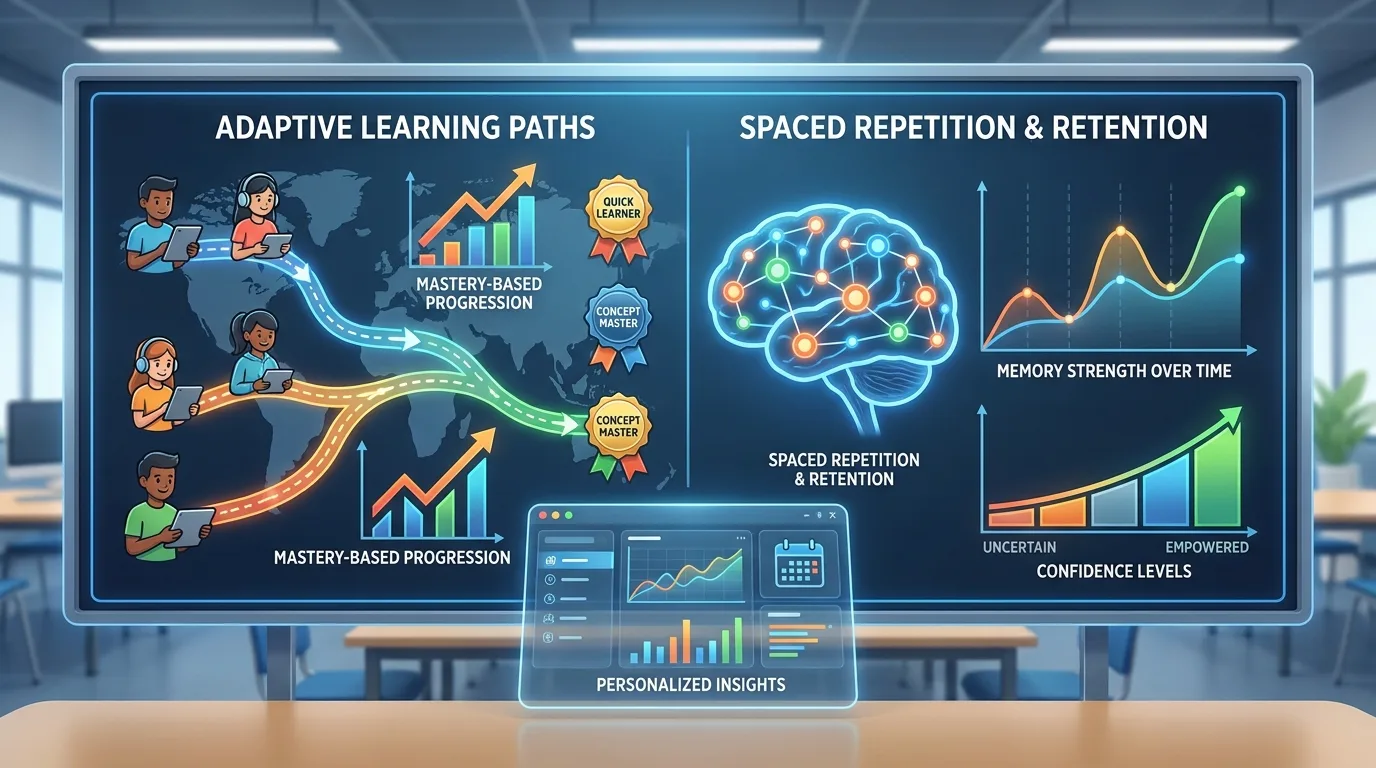
Khan Academy's adaptive learning paths are built on the principles of spaced repetition, microlearning, and mastery-based progression. This comprehensive approach encompasses:
Pre-Assessment
Initial evaluations help identify knowledge gaps and skill levels. Pre-assessments can be in the form of multiple-choice quizzes or short-answer questions that provide a baseline understanding of students' prior knowledge.
For example, a teacher may use a pre-assessment to determine which students need review on basic algebra concepts before moving forward with more advanced topics. This helps ensure that all students have a solid foundation and are not left behind due to gaps in their knowledge.
Dynamic Assessment
Ongoing assessments inform instruction, adjusting content difficulty and pace in real-time. Dynamic assessments might involve continuous feedback mechanisms, such as instant grading or automatic feedback loops, to ensure that students receive timely guidance on their progress.
Teachers can use dynamic assessment data to identify areas where students need extra support or challenge. For instance, if a student is consistently struggling with a particular concept, the teacher may adjust the instruction to provide more scaffolding or additional practice exercises.
Mastery-Based Progression
Students advance through levels only when they demonstrate mastery of previous material. Mastery-based progression means that students can't move forward until they've demonstrated a clear understanding of the material. This approach encourages deeper learning and reduces the likelihood of knowledge gaps.
By using mastery-based progression, teachers can ensure that students have a solid grasp of foundational concepts before moving on to more advanced topics. This helps prevent the creation of knowledge gaps and ensures that students are well-prepared for future challenges.
Spaced Repetition
Reviewing previously learned concepts at optimal intervals solidifies retention. Spaced repetition is based on the psychological principle that information is retained better when it's reviewed at increasingly longer intervals.
Teachers can use spaced repetition to help students retain previously learned material. For example, if a student has mastered a concept in math, the teacher may review it with them after a few weeks or months to reinforce their understanding and prevent forgetting.
Benefits for Teachers and Learners
Adaptive learning paths offer several advantages, including:
Improved Student Engagement
Personalized experiences foster motivation and interest in the subject matter. By catering to individual students' needs and interests, adaptive learning platforms can increase student engagement and motivation.
Teachers can use adaptive learning data to identify areas where students are struggling or disengaged. By adjusting instruction to meet their needs, teachers can help re-engage students and improve their overall performance.
Enhanced Learning Outcomes
Adaptive instruction ensures that students are challenged at their optimal level, potentially accelerating progress and reducing gaps. By providing tailored instruction, adaptive learning paths help teachers address knowledge gaps and accelerate student progress.
Teachers can use adaptive learning data to identify areas where students need extra support or challenge. By adjusting instruction accordingly, teachers can ensure that students are making consistent progress and achieving their full potential.
Data-Driven Insights
Real-time analytics provide teachers with actionable feedback on student performance. Data-driven insights enable teachers to make informed decisions about instruction, identifying areas where students need extra support or challenge.
Teachers can use adaptive learning data to inform their instructional decisions. For example, if a teacher notices that a group of students is struggling with a particular concept, they may adjust the instruction to provide additional support and scaffolding.
Conclusion
Adaptive learning paths offer a powerful tool for teachers and educators seeking to create more inclusive and effective learning environments. By leveraging AI-driven algorithms and data analytics, adaptive learning platforms can help identify individual differences in student learning styles and abilities, providing tailored instruction that accelerates progress and boosts confidence.
As the education landscape continues to evolve, it's clear that adaptive learning will play an increasingly important role in shaping the future of teaching and learning.
This Article was made with AI assistance and human editing.


