

Unlocking Privacy in DeFi: The Power of Zero-Knowledge Proofs
As decentralized finance (DeFi) continues to grow and evolve, one of its most pressing concerns has become apparent: privacy. With the increasing use of smart contracts, decentralized exchanges, and other blockchain-based technologies, users are beginning to worry about their sensitive information being exposed. But what if we told you that there's a way to enjoy the benefits of DeFi without sacrificing your anonymity? Enter zero-knowledge proofs (ZKPs), a revolutionary cryptographic technique that's set to change the game.
In this article, we'll delve into the world of ZKPs, exploring how they work and their applications in DeFi. We'll examine the benefits and limitations of these innovative tools, as well as provide practical examples to help you understand their potential.
What are Zero-Knowledge Proofs?
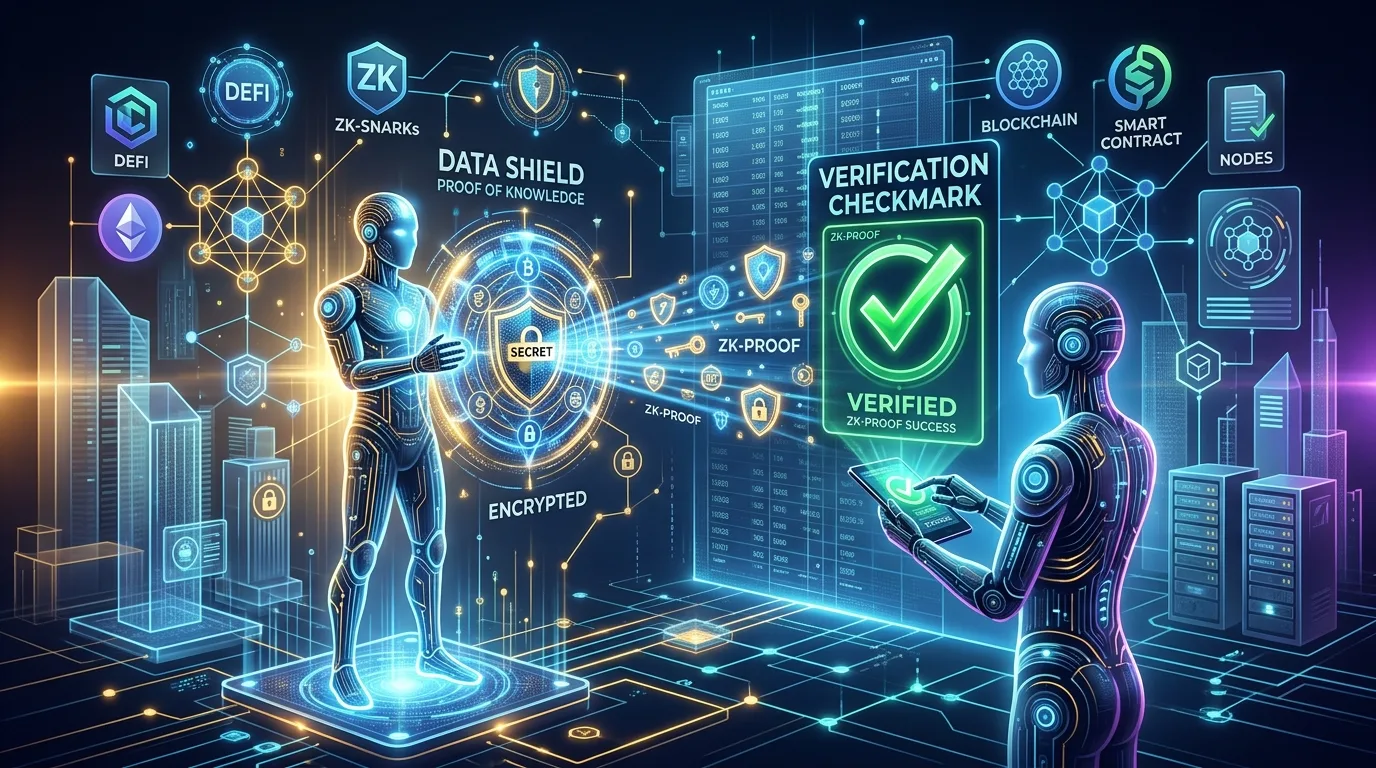
At its core, a zero-knowledge proof is a way for one party (the prover) to demonstrate to another party (the verifier) that they know something without revealing what that something actually is. In other words, the prover can convince the verifier of their claim without sharing any information about it.
Think of it like this: imagine you're trying to prove to a friend that you have a certain number of candies in your pocket without showing them the actual candies. You could use ZKPs to demonstrate that you indeed possess those candies, but without revealing how many or what kind they are.
To understand the concept better, let's break down the components involved:
Prover: The party providing the proof, who wants to convince the verifier of their claim.
Verifier: The party accepting the proof, who needs to be convinced of the prover's claim without revealing any information.
Secret: The underlying information that the prover is trying to keep private.
In terms of cryptography, ZKPs rely on advanced mathematical concepts such as homomorphic encryption and commitment schemes. These tools allow the prover to create a "proof" that can be verified by the verifier without compromising the underlying information.
How Do Zero-Knowledge Proofs Work in DeFi?
So how do ZKPs specifically apply to decentralized finance? Let's break it down:
Private Transactions
With traditional blockchain-based systems, all transactions are publicly visible. But what if you want to make a private payment without revealing the recipient or amount? That's where ZKPs come in – they enable private transactions that preserve user anonymity.
Here's an example of how this works:
1. Alice wants to send 10 units of cryptocurrency to Bob, but she doesn't want anyone else to know about it.
2. She uses a ZKP-based system to create a proof that she possesses the required amount of cryptocurrency without revealing the sender or recipient information.
3. The verifier (in this case, the blockchain network) accepts the proof and updates the ledger accordingly.
Verifiable Random Functions (VRFs)
VRFs are cryptographic primitives used in DeFi applications for tasks like random number generation and proof-of-stake validation. ZKPs can be used to ensure the verifiability of these functions, allowing users to trust that they're getting a truly random outcome.
For instance:
1. A decentralized exchange wants to generate a random sequence of numbers for its lottery.
2. The exchange uses a VRF-based system and pairs it with ZKPs to create a proof that the generated numbers are indeed random.
3. Users can verify the proof using ZKPs, ensuring that the outcome is fair and unbiased.
Smart Contract Security
Smart contracts often rely on complex mathematical computations to execute transactions. However, if an attacker were to find vulnerabilities in these contracts, they could exploit them for malicious gain. ZKPs can be used to prove the correctness of smart contract computations without revealing sensitive information.
Here's how it works:
1. A developer creates a smart contract that requires a complex mathematical computation.
2. The developer uses ZKPs to create a proof that the computation is correct without revealing any underlying information.
3. The verifier (in this case, another developer or a third-party auditor) accepts the proof and trusts that the contract will execute correctly.
Benefits and Limitations
Now that we've explored how ZKPs work in DeFi, let's examine their benefits and limitations:
Benefits
Security: ZKPs offer an additional layer of security by protecting user data from being exposed.
Privacy: By preserving anonymity, users can enjoy the benefits of DeFi without worrying about their sensitive information being compromised.
Trust: ZKPs enable trust between parties, ensuring that users can rely on each other's claims without revealing any underlying information.
Limitations
Complexity: ZKPs require advanced mathematical concepts and cryptographic techniques, making them challenging to implement and understand.
Scalability: Currently, ZKPs are not as scalable as traditional blockchain-based systems, which can limit their adoption in high-traffic applications.
Interoperability: ZKPs may not be compatible with existing DeFi infrastructure, requiring significant updates and upgrades.
Examples of Zero-Knowledge Proofs
Some examples of how ZKPs can be applied in various contexts include:
Secure voting systems
Private data sharing platforms
Confidential smart contracts
Anonymous identity verification
These examples demonstrate the potential of ZKPs to enhance security, privacy, and trust in decentralized finance.
Conclusion
Zero-knowledge proofs are a powerful tool for enhancing security, privacy, and trust in DeFi. By understanding how ZKPs work and their applications, developers can create more secure and private blockchain-based systems. While there are limitations to consider, the benefits of ZKPs make them an essential component of any decentralized finance ecosystem.
In conclusion, zero-knowledge proofs offer a promising solution for preserving user anonymity in DeFi while ensuring the integrity of transactions. As the industry continues to evolve, we can expect to see more widespread adoption and innovation in this area.
This Article was made with AI assistance and human editing.