

The Hidden Cost of Cheap Hosting on Your Ecommerce Revenue
Most ecommerce founders remember the day they launched their store. The adrenaline of going live, the first order notification, the pride of building something real. What far fewer remember is the hosting plan they clicked through during setup, often choosing the cheapest option just to get online. That decision quietly shapes every customer experience, every conversion, and every dollar of revenue that follows.
Think of your hosting provider as the physical foundation of a retail store. A beautiful shop with stunning products means nothing if the foundation cracks, the doors jam, or the power cuts out every few hours. Online, your hosting is that foundation. It determines how fast your pages load, how often your store is actually accessible, and how secure your customer data remains.

The ecommerce landscape in 2026 is brutally competitive. Shoppers have infinite alternatives, zero patience, and the ability to abandon your site in under three seconds. Your hosting plan is not a cost to minimize. It is a growth lever that either accelerates your business or quietly suffocates it. If you are searching for the best web hosting for ecommerce, this guide will show you exactly how hosting impacts every stage of your customer's journey, from first impression to final purchase, and how to choose infrastructure that scales with your ambition rather than caps it.
How Website Speed Directly Impacts Your Sales (With Real Numbers)
Speed is not a technical vanity metric. It is a direct line to revenue. When a potential customer taps your link from Instagram or Google, the clock starts ticking, and the margin for error is vanishingly small. Research consistently shows that a one-second delay in page load time reduces conversions by 7%, cuts page views by 11%, and drags customer satisfaction down by 16%. [^18^] Those numbers compound with every additional second.
The contrast between fast and slow sites is staggering. Websites that load in one second achieve conversion rates 2.5 times higher than those loading in five seconds. [^18^] On mobile, where the majority of ecommerce browsing now happens, the situation is even more severe. Google reports that 53% of mobile visitors abandon a page that takes longer than three seconds to load. [^19^] They do not wait, they do not refresh, they simply vanish to a competitor whose infrastructure responds faster.
A store generating $5,000 in daily revenue with a 2.5% conversion rate loses roughly 14 sales per day from a single second of delay, or over $125,000 annually. Two seconds of delay nearly doubles the damage. And these figures do not account for the long-term erosion of customer trust, repeat purchases, and word-of-mouth referrals that follow a consistently sluggish experience.
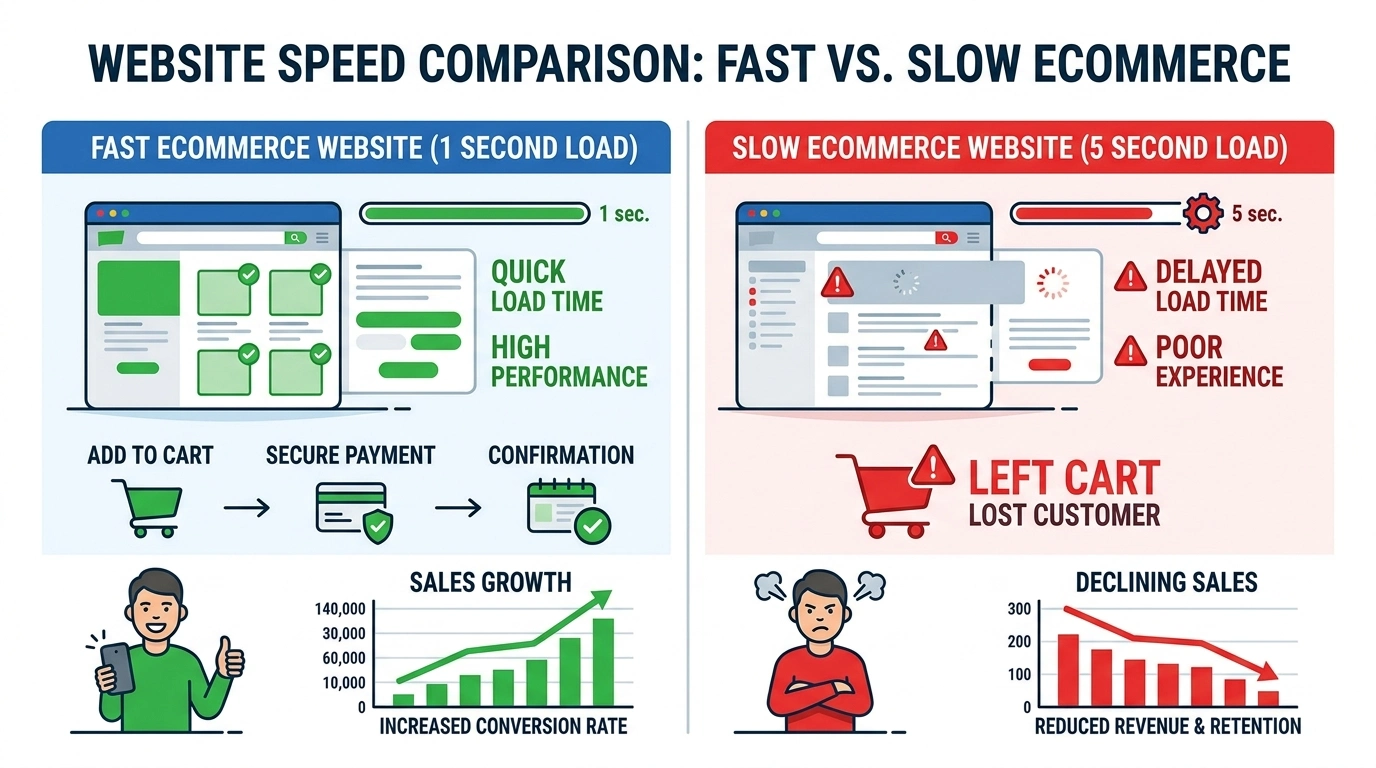
Investing in fast hosting for ecommerce is one of the highest-ROI decisions a store owner can make. Google's Core Web Vitals have raised the performance bar even higher. Sites with a Largest Contentful Paint (LCP) above three seconds experience 23% more traffic loss than faster competitors with equivalent content quality. [^23^] Poor Interaction to Next Paint (INP) scores above 300 milliseconds caused 31% drops in engagement, particularly on mobile devices. [^23^] Website speed for ecommerce is no longer optional. These metrics directly influence your search rankings and quantify the exact user frustration that kills sales.
Why Uptime Is Non-Negotiable for Online Stores
Every minute your store is offline, revenue walks out the door and does not come back. The average cost of downtime across industries ranges from $5,600 to $9,000 per minute, with ecommerce and retail specifically averaging around $10,000 per minute during normal operations. [^4^][^2^] For small businesses, the figure falls to $137-$427 per minute, still a painful bleed for a company watching every dollar. [^4^]
But direct revenue loss tells only part of the story. The true cost includes the support tickets that flood in, the team hours spent diagnosing issues, the social media complaints that damage your brand, and the customers who quietly decide never to return. Research shows that 67% of customers will never return to a website after experiencing a crash, and 89% will try a competitor within five minutes of an outage. [^8^]

Downtime disproportionately strikes at the worst possible moments. Black Friday, Cyber Monday, holiday sales, product launches, these are precisely the periods when your traffic spikes and your hosting infrastructure faces its greatest test. A mid-size ecommerce site losing €100-€500 per minute during normal operations can see that figure multiply by 10 to 15 times during peak periods. [^3^] The hosting plan that seemed adequate in March becomes a catastrophic bottleneck in November.
Website uptime is the silent foundation of ecommerce success. Reliable uptime starts with choosing a host that invests in redundant infrastructure, backup power systems, and proactive monitoring. Industry-standard uptime guarantees of 99.9% sound impressive until you realize that still permits over 43 minutes of downtime per month. For an ecommerce store, even that supposedly minor window translates to thousands in lost sales. The best hosts target 99.99% uptime or higher, backed by infrastructure designed to absorb traffic spikes without breaking a sweat.
Security, SSL Certificates, and Building Customer Trust
Every ecommerce transaction involves a silent psychological negotiation. The customer is asking themselves one question: can I trust this website with my personal and financial information? Your hosting environment provides the answer before they ever reach the checkout page. When browsers began marking non-HTTPS sites as \"Not Secure,\" the stakes became visible to every shopper. That little padlock icon in the address bar is not decorative. It is a trust signal that directly influences whether visitors proceed to purchase or retreat to safer ground.
An SSL certificate encrypts data exchanged between your customer's browser and your server, protecting sensitive information from interception. Beyond the security layer itself, SSL is a confirmed Google ranking factor, meaning sites without HTTPS start at a structural disadvantage in search visibility. Most quality hosting providers now include free SSL certificates through Let's Encrypt, auto-renewing them so you never have to worry about expiration.

When evaluating web hosting for ecommerce stores, security ranks among the top priorities. For stores processing credit card payments directly, PCI DSS compliance (Payment Card Industry Data Security Standard) becomes essential. PCI compliance encompasses twelve core requirements covering secure networks, vulnerability management, access controls, and regular security testing. [^1^] While using third-party processors like Stripe or PayPal reduces your compliance burden, your hosting environment must still meet baseline security standards. WordPress and WooCommerce are not PCI compliant out of the box, your hosting setup, security configurations, and payment processing choices must work together to satisfy requirements. [^1^]
Secure web hosting requires layered protection beyond the basics. The security conversation extends beyond SSL and PCI. Website security for ecommerce stores cannot be an afterthought. A quality ecommerce host provides Web Application Firewalls (WAF), DDoS protection, malware scanning, and automated backups. These layers protect against the brute force attacks, injection attempts, and distributed attacks that target online stores daily. One security breach can destroy customer trust permanently, making proactive protection far cheaper than reactive damage control.
Choosing the Right Hosting Type for Your Ecommerce Business
Not all hosting is created equal, and the plan that works for a personal blog will cripple an online store. Understanding the distinctions between hosting types helps you match infrastructure to your current needs while preserving room to grow.
If you're comparing providers after deciding which hosting type you need, Namecheap is worth considering because it offers shared, VPS, managed WordPress, and dedicated hosting under one account. That makes upgrading much easier as your ecommerce store grows instead of migrating to a completely new provider later.
Shared Hosting: The Affordable Starting Point
Shared hosting for ecommerce represents the most accessible entry point. Shared hosting places your website on a server alongside dozens or hundreds of other sites, all drawing from the same pool of CPU, memory, and bandwidth. Prices typically range from $5 to $20 per month, making it the most accessible entry point for new store owners. [^13^] For a brand-new shop with modest traffic, shared hosting can deliver acceptable performance while you validate your product and build initial momentum.
The trade-offs become apparent as you grow. Because resources are shared, a traffic spike on a neighboring site can slow your store or take it offline entirely, the infamous \"noisy neighbor\" effect. [^16^] For stores processing more than a handful of daily transactions, shared hosting quickly becomes a liability rather than an asset.
VPS Hosting: Dedicated Resources Without the Premium Price
VPS hosting for ecommerce bridges the gap between affordability and performance. Virtual Private Server (VPS) hosting carves out dedicated resources from a larger physical server using virtualization technology. Your store gets guaranteed CPU, RAM, and storage that no other customer can touch, ensuring consistent performance even during traffic spikes. Pricing typically falls between $20 and $90 per month. [^13^]
VPS hosting shines for growing ecommerce businesses because it eliminates the noisy neighbor problem while remaining far more affordable than dedicated servers. You gain root access for custom configurations, better security isolation, and the ability to scale resources up or down as needed. A regional ecommerce store seeing 15,000 daily visitors with seasonal jumps to 30,000 will find VPS hosting delivers the stability required for consistent sales without breaking the budget. [^13^]
Dedicated Hosting: Maximum Control for High-Volume Stores
Dedicated hosting assigns an entire physical server exclusively to your store. Every byte of RAM, every CPU core, every gigabyte of storage belongs to you. Performance is unmatched, security is absolute, and customization options are virtually unlimited. The cost reflects this exclusivity, ranging from $70 to over $1,000 per month. [^13^]
This tier makes sense for established stores with significant daily transaction volumes, custom application requirements, or strict compliance needs that demand complete environmental control. For most small to mid-size ecommerce businesses, dedicated hosting is overkill until you are processing thousands of transactions daily.
Managed WordPress Hosting: Optimized for WooCommerce Success
If your store runs on WooCommerce, finding the right hosting for WooCommerce becomes critical. Managed WordPress hosting deserves serious consideration. These environments are specifically optimized for WordPress performance, with server-level caching, CDN integration, and database tuning that generic hosting cannot match. Automatic updates for WordPress core, themes, and plugins remove security vulnerabilities before they become problems, while daily backups ensure you can recover quickly from any mishap. [^24^]

Managed WordPress hosting typically includes free SSL, staging environments for testing changes, and expert support staffed by WordPress specialists rather than generic technicians. The premium pricing, usually $20 to $50 per month, reflects the time savings and reduced risk. [^24^] For store owners who would rather focus on products, marketing, and customer relationships than server administration, managed WordPress hosting eliminates an entire category of technical headaches.
Cloud Hosting: Elastic Scaling for Unpredictable Growth
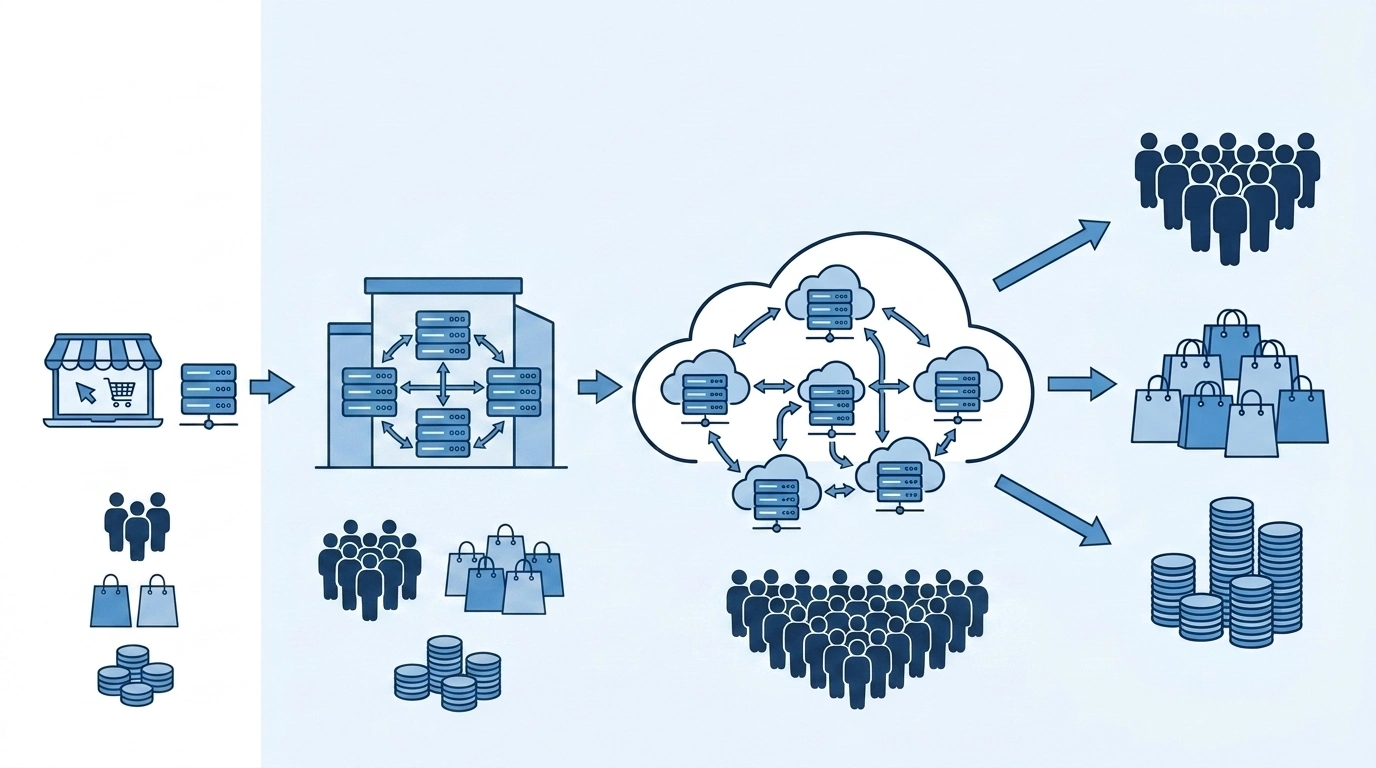
Cloud hosting distributes your store across a network of interconnected servers, automatically shifting resources to handle demand fluctuations. The primary advantage is elasticity. During a viral product moment or holiday rush, your infrastructure scales up instantly. During quiet periods, it scales down, so you only pay for what you use. Cloud hosting for ecommerce offers unique advantages for rapidly growing businesses. This model is particularly valuable for stores with unpredictable traffic patterns or those experiencing rapid growth.
Hosting Type | Monthly Cost | Best For | Key Advantage | Main Limitation |
|---|---|---|---|---|
Shared Hosting | $5 - $20 | New stores, low traffic | Lowest cost, easy setup | Shared resources, unpredictable performance |
VPS Hosting | $20 - $90 | Growing stores, 10K+ monthly visitors | Dedicated resources, scalable | Requires some technical knowledge |
Dedicated Hosting | $70 - $1,000+ | High-volume, enterprise stores | Maximum performance and control | Expensive, overkill for small stores |
Managed WordPress | $20 - $50 | WooCommerce stores | Optimized for WordPress, hands-off management | Limited to WordPress sites |
Cloud Hosting | Pay-as-you-go | Stores with variable traffic | Elastic scaling, high reliability | Costs can spike with traffic |
If You Are... | Recommended Plan |
|---|---|
Launching your first store | Shared Hosting |
Running a growing WooCommerce store | EasyWP Managed WordPress |
Getting consistent sales | VPS Hosting |
Running a large ecommerce brand | Dedicated Hosting |
These hosting types are available from providers such as Namecheap, allowing you to upgrade as your store grows without changing providers.
WooCommerce vs Shopify: The Hosting Factor
The choice between WooCommerce and Shopify often dominates ecommerce platform discussions, but the hosting dimension is frequently misunderstood. Shopify is a fully hosted solution, meaning hosting is bundled, managed, and invisible to the store owner. You pay a premium for this convenience, and you sacrifice granular control over performance optimization, server configuration, and custom integrations.
WooCommerce, by contrast, puts the hosting decision directly in your hands. This responsibility is actually an advantage for growth-oriented businesses. You can choose hosting infrastructure matched to your specific needs, optimize performance at the server level, and migrate between hosts as you scale. You are not locked into Shopify's pricing tiers or subject to their infrastructure limitations. With quality WordPress ecommerce hosting, WooCommerce can deliver performance that rivals or exceeds Shopify at a fraction of the long-term cost.
For entrepreneurs considering a move from Shopify to WooCommerce, or those choosing between platforms, the hosting flexibility of WordPress is a decisive factor. You can start affordably on shared hosting, graduate to VPS as sales grow, and eventually leverage dedicated or cloud infrastructure without rebuilding your store.
When to Upgrade Your Hosting Plan
Knowing when to move to a more powerful hosting tier is as important as choosing the right plan initially. Several warning signals indicate that your current infrastructure is constraining growth rather than supporting it.
Page load times exceeding three seconds are the most obvious red flag. If speed optimization efforts like image compression, caching plugins, and code minification fail to get your store below this threshold, your server resources are likely the bottleneck. Frequent downtime or error messages during checkout, particularly during traffic spikes, signal that your plan cannot handle concurrent visitors.
Other indicators include cart abandonment rates climbing without corresponding changes to your product or pricing, Google Search Console showing increasing Core Web Vitals failures, and your host regularly throttling bandwidth or CPU usage. The upgrade decision should be proactive rather than reactive. Waiting until a crash during a major sale costs far more than the monthly difference between hosting tiers.
Common Ecommerce Hosting Mistakes to Avoid
After consulting with dozens of store owners, I have observed the same costly mistakes repeating across businesses of every size. Avoiding these pitfalls can save you months of frustration and thousands in lost revenue.
Choosing hosting based solely on price. The cheapest plan is rarely the best value when you factor in lost sales from slow speeds, downtime during peak traffic, and the time spent dealing with technical issues. A $10 plan that costs you $500 in monthly lost conversions is exponentially more expensive than a $30 plan that delivers consistent performance.
Ignoring scalability. Many store owners select hosting for their current traffic without considering where they want to be in six or twelve months. A plan that works today but cannot handle tomorrow's growth forces a disruptive migration precisely when you should be focusing on selling.
Overlooking support quality. When your store goes down at 2 AM on a Saturday during a flash sale, the responsiveness and expertise of your hosting support team becomes priceless. Budget hosts that outsource support to untrained agents or limit support to business hours leave you stranded during your most critical moments.
Neglecting backup policies. Not all backups are created equal. Some hosts backup weekly rather than daily, others store backups on the same server as your site (useless if the server fails), and many charge extra for restore services. Verify that your host offers automated daily backups stored offsite with free, easy restoration.
Key Features to Look for in Ecommerce Hosting
Beyond the basic hosting type, specific features separate ecommerce-ready providers from generic hosts. When evaluating options, prioritize these capabilities:
Free SSL Certificate: Non-negotiable for trust and SEO. Should be included, auto-installed, and auto-renewed. [^28^]
99.9% or Higher Uptime Guarantee: Backed by SLA credits, not just marketing claims.
Content Delivery Network (CDN): Distributes your store's static assets across global servers, reducing load times for international customers.
Automatic Daily Backups: With easy one-click restoration and offsite storage.
Staging Environment: A clone of your live store where you can test updates, new plugins, and design changes without risk.
Free Website Migration: Professional transfer of your existing store without downtime or data loss.
24/7 Expert Support: Available via chat, phone, or ticket with ecommerce-relevant expertise.
WooCommerce Optimization: Server configurations specifically tuned for WordPress ecommerce performance.
Scalability Options: Clear upgrade paths to higher tiers without forced migrations.
DDoS Protection and WAF: Essential security layers for any store processing payments.
If you are evaluating hosting providers, don't just compare price. Look for free SSL, automatic backups, a CDN, website migration, responsive support, and a clear upgrade path as your business grows.
For example, Namecheap offers shared hosting, VPS, managed WordPress, and dedicated servers, along with free SSL on eligible plans, free website migration, and 24/7 support. Rather than recommending a single host for every business, it's better to compare features and choose the provider that best matches your current traffic, budget, and long-term growth plans.
Frequently Asked Questions About Ecommerce Hosting
Can I start an ecommerce store on shared hosting?
Yes, shared hosting can work for brand-new stores with very low traffic and minimal daily transactions. It is the most affordable way to validate your business idea and make your first sales. However, once you are processing consistent orders or driving meaningful traffic through marketing, upgrading to VPS or managed WordPress hosting will deliver noticeably better performance and reliability.
How much does ecommerce hosting typically cost?
Ecommerce hosting ranges from approximately $5 per month for basic shared plans to $1,000 or more for dedicated enterprise servers. Most growing WooCommerce stores find the sweet spot between $20 and $90 per month for VPS or managed WordPress hosting that delivers dedicated resources, strong security, and room to scale.
Does hosting affect my Google rankings?
Yes, indirectly but significantly. Hosting impacts page speed, uptime, and security, all of which are confirmed Google ranking factors. Sites with slow Largest Contentful Paint scores or frequent downtime see measurable traffic losses compared to faster, more reliable competitors. [^23^]
Is managed WordPress hosting worth the extra cost?
For most WooCommerce store owners, yes. The time saved on updates, security monitoring, performance optimization, and troubleshooting typically far exceeds the monthly price difference. Managed hosting also reduces the risk of catastrophic failures from outdated plugins or missed security patches.
What is PCI compliance and do I need it?
PCI DSS (Payment Card Industry Data Security Standard) is a set of security requirements for any business that processes credit card transactions. If you accept payments directly on your site, you must comply. Using third-party processors like Stripe or PayPal reduces your compliance burden, but your hosting environment must still meet baseline security standards. [^1^]
How do I know when my store has outgrown its hosting plan?
Watch for page load times consistently exceeding three seconds, increased cart abandonment, error messages during checkout, downtime during traffic spikes, and warnings from your host about resource limits. Proactive monitoring tools like Google PageSpeed Insights and uptime monitors help you spot degradation before it impacts sales.
Can I switch hosting providers without losing my store?
Yes, with proper planning. Most reputable hosts offer free migration services that transfer your files, databases, and configurations without downtime. Always create a full backup before initiating any migration.
Do I need a CDN for my ecommerce store?
A CDN is highly recommended for any store with customers in multiple geographic regions. It caches static assets like images, CSS, and JavaScript on servers worldwide, delivering them from the location nearest to each visitor. Many quality hosts include CDN integration at no extra cost.
Building Your Store on a Foundation That Scales
Every successful ecommerce business eventually faces the same inflection point: the infrastructure that launched the store becomes the constraint preventing its next stage of growth. Recognizing this moment before it arrives, and choosing hosting that anticipates your trajectory rather than reacting to it, separates stores that plateau from stores that scale.
The right ecommerce hosting is not about buying the most expensive plan or chasing the latest technology trend. It is about matching infrastructure to your business reality while preserving the flexibility to evolve. A new dropshipping store has different needs than a seven-figure WooCommerce brand, but both require the same foundational qualities: reliable uptime, fast page loads, robust security, and support that shows up when things go wrong.
As you evaluate your current hosting situation or plan your store launch, focus on the metrics that directly impact revenue. Test your page speed regularly. Monitor your uptime. Audit your security setup. And most importantly, choose a hosting partner that offers clear upgrade paths as your business grows. Whether that means starting with affordable shared hosting and graduating to VPS, or launching directly on managed WordPress optimized for WooCommerce, the key is making an intentional choice rather than accepting whatever default option appears first.
Your products deserve a store that loads instantly, stays online, and protects your customers. Your marketing deserves the conversion rates that only fast, reliable infrastructure can deliver. And your business deserves a hosting foundation built for the revenue milestones you are working toward, not just the ones you have already hit.
Sources & References
PCI Security Standards Council – PCI DSS Documentation
IBM – Cost of Data Breach Report
Pingdom – Website Downtime Statistics
Google Search Central – Core Web Vitals
Google Developers – HTTPS as a Ranking Signal
Cloudflare Learning Center – CDN Explained
Google PageSpeed Insights Documentation
Let's Encrypt Documentation
WooCommerce Official Documentation
WordPress Hosting Handbook
This Article was made with AI assistance and human editing.


