

Why Your Choice of Domain Registrar and Host Actually Matters
Every website starts with two decisions that most people rush through: where to register the domain and where to host it. These choices feel technical and interchangeable, so beginners often default to whichever brand they have heard of or whichever option appears first in a Google search. Months later, they are stuck with inflated renewal bills, privacy upsells, support queues that never end, and the sinking realization that migrating everything would cost more time and money than simply tolerating the mediocrity.
I have worked with hundreds of website owners over the years, and the pattern is remarkably consistent. The ones who thrive are not necessarily the most technical. They are simply the ones who chose infrastructure partners that respect their time, protect their privacy, and do not punish them with surprise pricing. This review breaks down exactly what Namecheap delivers, where it falls short, how it compares to the competition, and whether it deserves a place in your web stack.

Quick Verdict: Should You Choose Namecheap?
If you want the short answer before diving into the details, here it is. Namecheap excels at providing affordable domains with free lifetime WHOIS privacy, straightforward hosting plans without aggressive upselling, and a clean management interface that keeps everything in one place. It is not the fastest host on the market, nor does it offer the most advanced features for power users. But for entrepreneurs, bloggers, small business owners, and anyone who values transparent pricing over marketing flash, Namecheap delivers exceptional value.
Verdict Category | Assessment |
|---|---|
Best For | Budget-conscious founders, domain investors, WordPress beginners, small businesses, privacy-focused users |
Not Ideal For | High-traffic ecommerce stores needing sub-second load times, enterprises requiring dedicated account managers, users who need phone support |
Overall Recommendation | Strong choice for domain registration and entry-to-mid-level hosting |
Key Strengths | Free WHOIS privacy, affordable domains, no aggressive upsells, clean interface, 24/7 chat support, wide hosting variety |
Biggest Drawback | Shared hosting performance lags behind LiteSpeed-powered competitors; no phone support |
Namecheap Rating Summary
The following ratings reflect Namecheap's performance across key categories based on independent testing, user feedback, and feature analysis. These are realistic scores, not inflated marketing numbers.
Category | Rating | Notes |
|---|---|---|
Domain Pricing & Value | 4.7/5 | Competitive intro pricing with free WHOIS privacy; renewals are fair |
Hosting Performance | 3.8/5 | Solid uptime at 99.98% but TTFB of 461ms trails LiteSpeed hosts |
Ease of Use | 4.5/5 | Clean cPanel, intuitive dashboard, easy WordPress setup |
Pricing Transparency | 4.6/5 | No hidden fees; renewal jumps are industry-standard but clearly disclosed |
Features | 4.2/5 | Free SSL, backups, migration; lacks staging on lower tiers |
Customer Support | 4.0/5 | 24/7 live chat with knowledgeable staff; no phone support |
Security | 4.5/5 | Free SSL, WHOIS privacy, 2FA, DDoS protection, malware scanning |
Scalability | 4.3/5 | Clear upgrade path from shared to VPS to dedicated servers |
Beginner Friendliness | 4.6/5 | Low barrier to entry, helpful onboarding, affordable starter plans |
Overall Score | 4.4/5 | Excellent value for domains and entry-level hosting |
Who Should Use Namecheap
Namecheap fits a specific profile of user particularly well. If you see yourself in any of the following categories, this platform is likely a strong match for your needs.
First-time website owners benefit enormously from Namecheap's low barrier to entry. The Stellar shared hosting plan starts at around $1.98 per month for the first year and includes a free domain, SSL certificate, and website migration. [^32^] For someone launching their first blog, portfolio, or small business site, this package removes nearly every financial and technical obstacle.
Domain investors and multi-site owners will appreciate the free WHOIS privacy that comes with every eligible domain registration. Competitors like GoDaddy charge upwards of $10 per year per domain for this same protection, which adds up quickly when you manage dozens or hundreds of domains. [^34^] Namecheap's domain management interface also makes bulk operations, DNS configuration, and transfer management refreshingly straightforward.
Privacy-conscious users gravitate toward Namecheap because of the company's public advocacy for internet freedom and consumer rights. The free WHOIS privacy, SSL certificates, and two-factor authentication create a security baseline that many competitors treat as premium add-ons. [^39^]
WooCommerce and WordPress users can take advantage of the EasyWP managed hosting platform, which offers cloud-based WordPress hosting with automatic updates, built-in caching, and CDN integration at prices that undercut most managed WordPress competitors. [^52^]
Who Should Avoid Namecheap
No provider is perfect for everyone, and Namecheap has clear limitations that make it a poor fit for certain use cases. Understanding these boundaries upfront saves you from disappointment later.
High-traffic ecommerce stores should look elsewhere for their primary hosting. While Namecheap's shared and VPS plans can handle moderate traffic, independent benchmarks show a TTFB (Time to First Byte) of 461 milliseconds on shared hosting, which places it in the average tier rather than the elite tier. [^31^] For stores processing hundreds of transactions daily, hosts with LiteSpeed servers and NVMe storage like Hostinger or ScalaHosting deliver measurably faster page loads.
Users who need phone support will find Namecheap frustrating. The company offers 24/7 live chat and a comprehensive knowledge base, but phone support is not available. [^36^] If you prefer resolving complex issues through a voice conversation, competitors like HostGator and Bluehost provide phone support as a standard option.
Enterprise clients requiring white-glove service will find Namecheap's support structure too lean. The company focuses on self-service efficiency and chat-based assistance, which works well for small businesses but does not provide the dedicated account management or priority escalation channels that large organizations typically require.
Namecheap Domain Registration: Where It Truly Leads
Namecheap built its reputation on domain registration, and this remains the strongest pillar of its business. A .com domain costs $11.28 for the first year and renews at $18.48 annually, which sits comfortably below GoDaddy's renewal rates and includes features that competitors charge extra for. [^32^]

The standout feature is free WHOIS privacy protection on every eligible domain. ICANN requires your contact information to be publicly listed in the WHOIS database, exposing you to spam and potential identity theft. Namecheap masks this information at no charge, while GoDaddy charges approximately $9.99 per year per domain for the same service. [^34^]
The domain management dashboard deserves praise for its clarity. DNS configuration, nameserver updates, domain forwarding, and auto-renewal settings are all accessible from a single, uncluttered interface. Bulk operations work smoothly, and the domain search tool provides helpful suggestions when your first choice is unavailable. For users managing multiple domains, these small usability advantages compound into significant time savings.
Namecheap Hosting Plans Explained
Beyond domains, Namecheap offers a full spectrum of hosting options that scale from hobby blogs to enterprise-grade dedicated servers. Understanding the differences between these plans helps you choose the right foundation for your specific needs.

Shared Hosting (Stellar Plans)
The Stellar shared hosting lineup serves as Namecheap's entry point. Three tiers provide increasing resources: Stellar offers 20 GB SSD storage and 3 websites for approximately $1.98 per month introductory; Stellar Plus provides unmetered SSD storage and unlimited websites for around $2.50 per month; Stellar Business delivers 50 GB SSD storage, unlimited websites, and cloud storage redundancy for roughly $4.98 per month. [^28^]
All shared plans include cPanel access, Softaculous one-click installs, free SSL certificates for the first year, free website migration, and email accounts. The storage uses SSD technology, which delivers faster read and write speeds than traditional hard drives, though it is not the faster NVMe standard that some competitors now offer. [^49^]
EasyWP Managed WordPress Hosting
EasyWP is Namecheap's managed WordPress solution built on a proprietary cloud platform. It promises setup in under 30 seconds, automatic WordPress updates, three levels of server-side caching, and CDN integration even on the starter plan. [^52^] Pricing begins at $0 for the first month (then $9.88 monthly) for the Starter plan, which includes 10 GB NVMe storage and supports approximately 50,000 monthly visitors. [^32^]
The Turbo plan at $13.88 per month ($18.88 on renewal) increases storage to 50 GB and supports around 200,000 visitors, while the Supersonic tier at $26.88 per month delivers 100 GB storage with 4 vCPUs and 1,152 MB RAM. [^32^] EasyWP does not use cPanel; instead, it offers a streamlined dashboard focused exclusively on WordPress management, which simplifies the experience for non-technical users but limits advanced customization options.
VPS and Dedicated Servers
For users who have outgrown shared hosting, Namecheap offers VPS plans starting at $82.56 per year for the Pulsar tier (2 CPU cores, 2 GB RAM, 40 GB SSD) and dedicated servers starting at approximately $37.66 per month for the Xeon E3-1230 v5 configuration. [^32^][^44^] VPS plans include full root access and a choice of operating systems, while dedicated servers provide bare-metal performance for mission-critical applications. Both tiers are housed at the PhoenixNAP data center in Phoenix, Arizona.
Reseller Hosting
Namecheap's reseller program starts at $19.88 per month for the Nebula plan, which includes 25 cPanel accounts and 30 GB SSD storage. [^53^] The Galaxy Expert and Universe Pro tiers scale to 100 and 150 cPanel accounts respectively, all with unmetered bandwidth, free WHM control, and white-label capabilities. This offering targets web designers, developers, and agencies who want to bundle hosting with their client services.
Hosting Type | Starting Price | Best For | Key Feature |
|---|---|---|---|
Stellar Shared | $1.98/mo | Blogs, portfolios, small sites | cPanel, 20 GB SSD, 3 websites |
EasyWP Starter | $0 first month | WordPress beginners | Cloud platform, auto updates, CDN |
VPS Pulsar | $6.88/mo | Growing sites needing dedicated resources | Full root access, SSD storage |
Dedicated Xeon E3 | $37.66/mo | High-traffic, mission-critical sites | Bare metal, 4 cores, 8 GB RAM |
Reseller Nebula | $19.88/mo | Agencies, web designers | 25 cPanel accounts, WHM |
Performance and Uptime: The Real Numbers
Marketing claims about speed and reliability mean little without independent verification. According to HostingStep's Q4 2025 benchmarks, which monitored Namecheap across 90 days and over 52,000 tests, the shared hosting platform delivered a TTFB of 461 milliseconds, an uptime of 99.98%, and a global TTFB of 448 milliseconds. [^31^]

The 99.98% uptime is excellent, representing just minutes of downtime per quarter. The 461ms TTFB places Namecheap in the average performance tier, faster than GoDaddy Shared (751ms) but slower than Hostinger Business (478ms). [^31^] For most personal websites and small business sites, this level of performance is perfectly adequate. Visitors will not notice sub-half-second response times.
The load handling test showed a response time of 150ms with moderate resource allocation (WPBench score of 5.0/10), confirming that Namecheap's entry-level plans can handle typical traffic loads without buckling. [^31^] The platform does not use LiteSpeed servers or NVMe storage on shared plans, technologies that competitors like Hostinger leverage to achieve faster page loads. This is the primary trade-off you accept in exchange for Namecheap's lower pricing and cleaner user experience.
How Namecheap Compares to Competitors
Choosing a web host requires context. Namecheap's strengths become clearer when you compare it directly against the most popular alternatives.
Namecheap vs Hostinger
Hostinger delivers faster performance, with websites loading in under one second thanks to LiteSpeed servers, while Namecheap averages 1.8 to 2.5 seconds on shared hosting. [^37^] However, Namecheap wins on domain pricing and privacy. Hostinger's free domain offering excludes .com on some plans, and domain renewals are often higher. [^38^] Namecheap's free lifetime WHOIS privacy makes it the better choice for users prioritizing domain services.
Namecheap vs GoDaddy
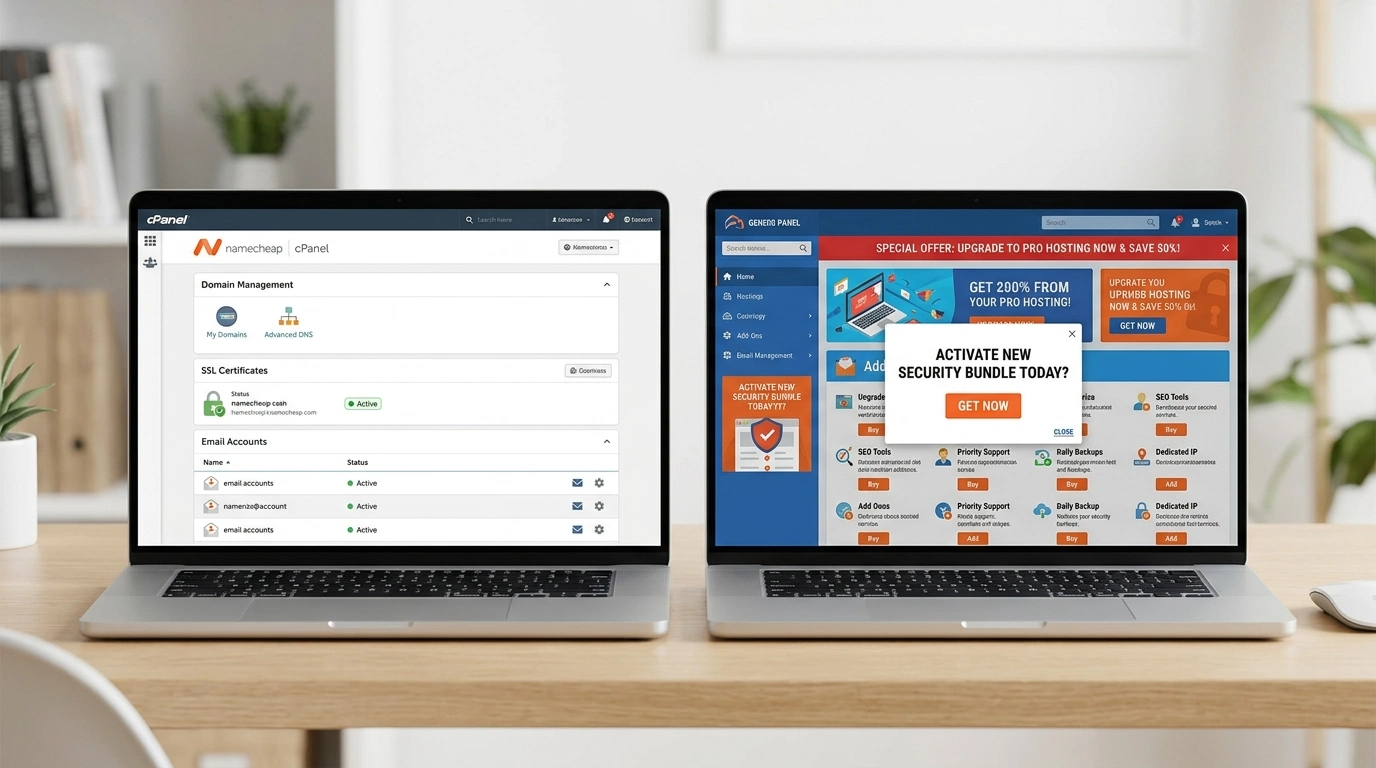
GoDaddy charges for WHOIS privacy, pushes aggressive upsells, and has confusing pricing structures. [^34^] Namecheap includes privacy for free, minimizes upsells, and presents pricing transparently. The interface difference is equally stark: Namecheap's clean dashboard versus GoDaddy's cluttered, promotion-heavy experience.
Namecheap vs Bluehost
Bluehost enjoys official WordPress.org recommendation with plans starting at $2.95 per month. [^35^] However, Bluehost's renewal rates climb steeply, and its custom control panel lacks cPanel's familiarity. Namecheap matches Bluehost on core features while undercutting it on domain pricing and long-term value.
Namecheap vs SiteGround
SiteGround offers superior performance but renewal pricing jumps by over 500%, making it one of the most expensive budget hosts long-term. [^32^] Namecheap's renewal increases are far more modest at 23-114%. SiteGround makes sense for users needing elite performance; Namecheap delivers comparable reliability at a fraction of the price.
Feature | Namecheap | Hostinger | GoDaddy | Bluehost | SiteGround |
|---|---|---|---|---|---|
Shared Hosting Start | $1.98/mo | $2.49/mo | $4.95/mo | $2.95/mo | $2.99/mo |
Free WHOIS Privacy | Yes | Yes | No ($9.99/yr) | Yes | Yes |
Free SSL | Yes (Year 1) | Yes (Lifetime) | Yes (Year 1) | Yes | Yes |
Control Panel | cPanel | hPanel | cPanel | Custom | Site Tools |
Uptime (Q4 2025) | 99.98% | 99.98% | 99.99% | 99.9% | 99.9% |
TTFB | 461ms | 478ms | 751ms | 224ms | 632ms |
Phone Support | No | No | Yes | Yes | Yes |
Renewal Jump | 23-114% | Moderate | High | High | 501%+ |
Security Features and Privacy Protection
Namecheap approaches security as a baseline right rather than a premium upsell. Every eligible domain registration includes free WHOIS privacy protection through Withheld for Privacy, which replaces your personal contact information in the public WHOIS database with anonymized proxy data. [^39^] This single feature saves users $10 or more per domain annually compared to registrars that charge for privacy.
On the hosting side, all plans include free SSL certificates through Let's Encrypt, with auto-installation and renewal. Two-factor authentication protects account access with support for U2F hardware keys and TOTP authenticator apps. DDoS protection and Supersonic CDN integration help prevent outages from malicious traffic, while automatic malware scanning through MalwareGuardian and HackGuardian monitors for threats. [^40^]
Backup policies vary by plan. Shared hosting accounts receive twice-weekly automatic backups on lower tiers and daily backups on Stellar Business. EasyWP managed hosting includes daily backups across all plans. Users can also create manual backups on demand through cPanel. The 30-day money-back guarantee on hosting plans provides a risk-free window to evaluate the service.
Customer Support: What to Expect
Namecheap's support model centers on 24/7 live chat, supplemented by an extensive knowledge base and community forums. Response times typically fall under five minutes, and the support staff are generally knowledgeable, particularly for domain-related issues where Namecheap's expertise runs deepest. [^28^]

The absence of phone support is the most commonly cited limitation. Users who encounter complex technical issues sometimes report that chat-based escalation can be slow, and support quality varies depending on the specific problem and time of day. [^36^] For domain management questions, DNS configuration help, and basic hosting troubleshooting, the chat support performs reliably well. For advanced server-level issues on VPS or dedicated plans, the experience can be more inconsistent.
The knowledge base stands out as a genuine asset. Articles are well-written, frequently updated, and cover everything from beginner setup guides to advanced DNS configuration. For self-sufficient users who prefer finding answers independently, this resource reduces dependency on live support significantly.
Common Concerns Addressed
Potential customers often raise specific objections before committing to Namecheap. Here are the most common concerns, answered honestly.
Is Namecheap too cheap to be reliable? Namecheap's 99.98% uptime, transparent practices, and 25-year track record demonstrate that affordable pricing does not mean compromised reliability. The company serves over 2 million customers with a 4.7 out of 5 rating. [^46^]
Will I get hit with hidden fees? Namecheap's pricing is among the most transparent in the industry. Renewal rates are clearly displayed before purchase, and the checkout process does not bombard you with pre-checked add-ons like some competitors. The only fees to watch are the standard ICANN domain fee of $0.20 per year and optional upgrades like PremiumDNS.
Is migration difficult? Namecheap offers free website migration for cPanel-to-cPanel transfers, which covers the vast majority of moves from shared hosting providers. The process is handled by their support team with minimal downtime. For non-cPanel migrations, manual transfer is possible with their guidance. [^49^]
Can I upgrade my plan later? Yes, and this is one of Namecheap's structural advantages. Because the company offers everything from shared hosting to VPS to dedicated servers, you can scale within the same ecosystem without the friction of switching providers. A site that starts on Stellar shared hosting can graduate to VPS and eventually dedicated infrastructure as traffic grows.
Frequently Asked Questions
Is Namecheap good for beginners?
Yes. Namecheap is one of the most beginner-friendly providers available. The Stellar shared hosting plan starts at approximately $1.98 per month, includes a free domain and SSL certificate, and uses the familiar cPanel control panel. The one-click WordPress installer through Softaculous gets a website running in minutes, and the knowledge base covers every common beginner question.
Does Namecheap offer free domain privacy?
Yes. Every eligible domain registration or transfer includes free WHOIS privacy protection for the lifetime of the domain. This masks your personal contact information in the public WHOIS database, protecting you from spam and unwanted solicitations. Competitors like GoDaddy charge $9.99 or more per year for this same service.
How does Namecheap's uptime compare to competitors?
Namecheap delivered 99.98% uptime in Q4 2025 independent testing, which translates to roughly 8 minutes of downtime per month. This matches Hostinger (99.98%) and trails only slightly behind GoDaddy Shared (99.99%). For context, the industry standard SLA is 99.9%, which allows over 43 minutes of monthly downtime.
What is EasyWP and who is it for?
EasyWP is Namecheap's managed WordPress hosting platform built on cloud infrastructure. It offers faster setup, automatic WordPress updates, server-side caching, and CDN integration compared to traditional shared hosting. EasyWP is ideal for WordPress users who want a streamlined, hands-off experience without the premium pricing of competitors like WP Engine or Kinsta.
Can I host multiple websites on Namecheap?
Yes. The Stellar Plus and Stellar Business shared hosting plans allow unlimited websites, while the entry-level Stellar plan supports up to 3 websites. VPS and dedicated server plans can host as many websites as your resources allow. EasyWP plans, however, each support only a single WordPress site.
Does Namecheap charge for SSL certificates?
Namecheap provides free SSL certificates through Let's Encrypt on all hosting plans for the first year. Shared hosting plans include free SSL renewal, though some plans may require manual reinstallation. EasyWP plans include SSL as a standard feature. For standalone SSL purchases, Namecheap offers competitive pricing on premium certificates with multi-year lock-in options.
Is Namecheap better than GoDaddy for domains?
For most users, yes. Namecheap offers lower renewal pricing, free WHOIS privacy, a cleaner management interface, and significantly less aggressive upselling. GoDaddy's introductory prices may appear competitive, but the addition of paid privacy protection, higher renewals, and constant promotional clutter makes Namecheap the better long-term value.
What happens when my introductory pricing expires?
Namecheap's renewal rates increase from introductory prices, which is standard industry practice. Shared hosting renewals jump approximately 113%, while VPS renewals see more modest increases of 23-29%. [^32^] These increases are clearly disclosed at checkout, and you can lock in lower rates by registering for multi-year terms upfront or watching for promotional renewal codes.
Can I get a refund if I am not satisfied?
Namecheap offers a 30-day money-back guarantee on all hosting plans. Domain registrations are generally non-refundable once purchased, though there is a brief grace period for certain TLDs. The refund policy allows you to test the hosting service risk-free before committing long-term.
Final Verdict: Is Namecheap Right for You?
Namecheap has earned its position as one of the most trusted names in domains and budget hosting through two decades of consistent value, transparent pricing, and genuine respect for user privacy. It is not the fastest host, nor does it offer the most hand-holding for enterprise clients. What it delivers is something more fundamental: a reliable, affordable foundation for getting online without the friction, upsells, and surprise bills that plague so many competitors.
If you are launching your first website, managing a portfolio of domains, or running a small business that needs dependable hosting without enterprise-level complexity, Namecheap deserves serious consideration. The combination of free WHOIS privacy, competitive domain pricing, a clean management interface, and a clear upgrade path from shared to dedicated hosting creates an ecosystem that grows with you.
For users who need absolute maximum speed and are willing to pay a premium for it, competitors like Hostinger or SiteGround may be worth the extra cost. For users who require phone support or dedicated account management, Bluehost or GoDaddy might fit better. But for the vast majority of website owners who want solid performance, fair pricing, and a company that treats them like customers rather than revenue targets, Namecheap remains one of the smartest choices in 2026.
If this matches your requirements, you can explore Namecheap's latest domain and hosting plans to compare current pricing and features. Starting with the right infrastructure partner is one of the few decisions about your website that you will never regret.
This Article was made with AI assistance and human editing.


