

Imagine being connected to someone across the globe in such a way that what happens to one of you instantly affects the other, regardless of the distance between you. Sounds like science fiction? Think again. This phenomenon is known as entanglement, and it's a fundamental concept in quantum mechanics.
Entanglement was first described by Albert Einstein in 1935, along with Boris Podolsky and Nathan Rosen, in their famous EPR paper (Einstein et al., 1935). However, it wasn't until the 1960s that physicist John Bell showed that entanglement could be used to test the principles of quantum mechanics. Today, entanglement is a hot topic in physics research, with potential applications in quantum computing and cryptography.
In this article, we'll delve into the world of entanglement, exploring what it is, how it works, and its implications for our understanding of reality.
What is Entanglement?
Entanglement occurs when two or more particles become correlated in such a way that their properties are linked together. This means that if something happens to one particle, the state of the other particles will be instantly affected, regardless of the distance between them.
To understand entanglement better, let's consider an analogy. Imagine two dancers performing a choreographed routine. If one dancer makes a movement, the other dancer will respond in kind, even if they're on opposite sides of the stage. This is similar to what happens with entangled particles – when something happens to one particle, the state of the other particles is instantly affected.
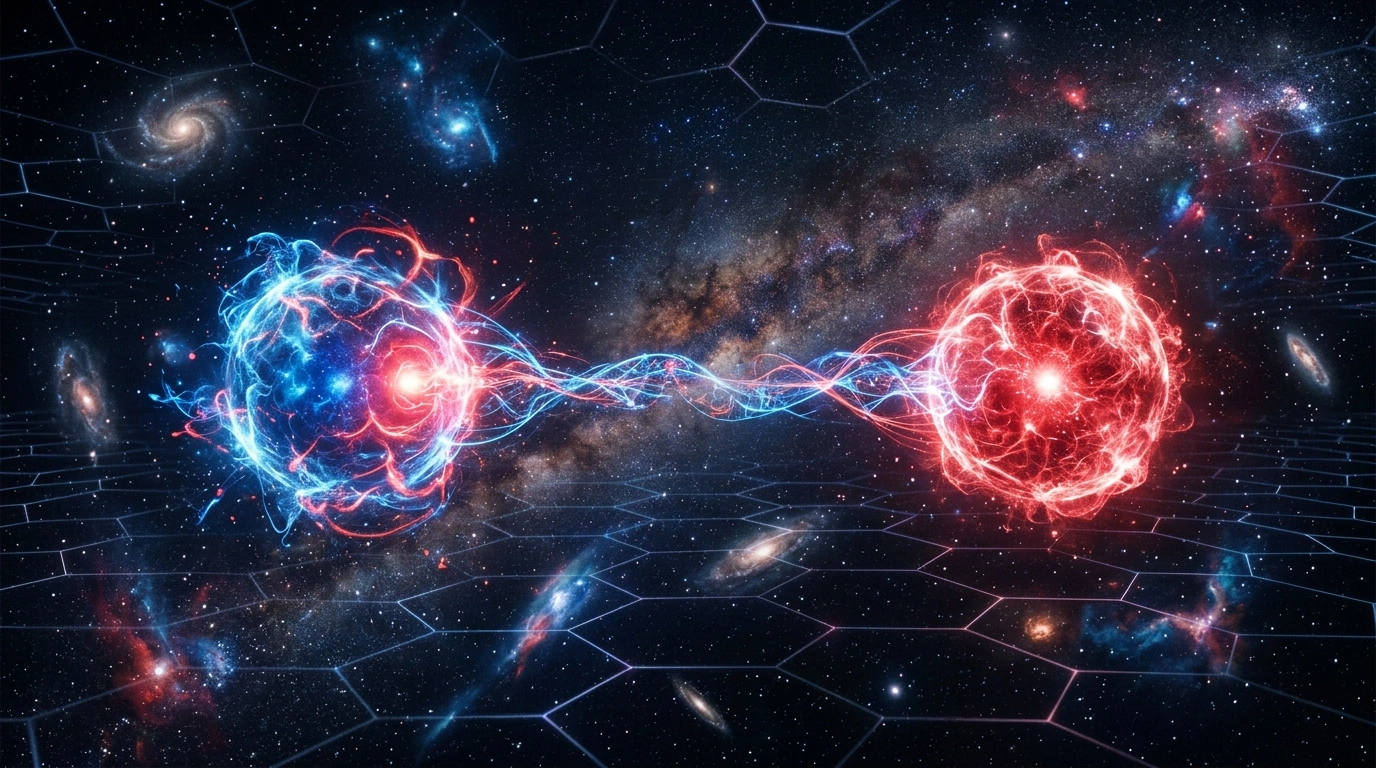
Entanglement can be thought of as a non-local connection between particles. It's not just a matter of space-time distance; it's a fundamental aspect of quantum mechanics that challenges our classical understanding of reality.
Key Features of Entanglement
Here are some key features of entanglement:
• Non-locality: Entanglement allows for instant communication between particles, regardless of distance.
• Correlation: Entangled particles become correlated in such a way that their properties are linked together.
• Instantaneity: Changes to one particle instantly affect the state of the other particles.
These features are essential to understanding entanglement and its implications. Let's break down each feature further:
Non-locality
Entanglement is often referred to as a non-local phenomenon because it allows for instant communication between particles, regardless of distance. This means that if something happens to one particle, the state of the other particles will be instantly affected.
To understand this better, consider the following example:
Imagine two electrons, each with a spin of either +1/2 or -1/2.
If these electrons are entangled, measuring the spin of one electron will instantly affect the state of the other electron, regardless of distance.
This means that if we measure the spin of one electron to be +1/2, the other electron will instantly become -1/2, and vice versa.
Correlation
Entangled particles become correlated in such a way that their properties are linked together. This correlation is not just a matter of probability; it's a fundamental aspect of quantum mechanics.
To understand this better, let's consider the following example:
Imagine two photons, each with a polarization of either horizontal or vertical.
If these photons are entangled, measuring the polarization of one photon will instantly affect the state of the other photon, regardless of distance.
This means that if we measure the polarization of one photon to be horizontal, the other photon will instantly become vertical, and vice versa.
Instantaneity
Changes to one particle instantly affect the state of the other particles. This is a fundamental aspect of entanglement that challenges our classical understanding of reality.
To understand this better, let's consider the following example:
Imagine two electrons, each with a spin of either +1/2 or -1/2.
If these electrons are entangled, measuring the spin of one electron will instantly affect the state of the other electron, regardless of distance.
This means that if we measure the spin of one electron to be +1/2, the other electron will instantly become -1/2, and vice versa.
How Does Entanglement Work?
Entanglement is a fundamental aspect of quantum mechanics, which describes the behavior of particles at the atomic and subatomic level. According to the principles of quantum mechanics, particles can exist in multiple states simultaneously – a phenomenon known as superposition.
When two particles become entangled, their wave functions become linked together. This means that if something happens to one particle, the state of the other particles will be instantly affected, regardless of distance.
Here's an example:
Imagine two electrons, each with a spin of either +1/2 or -1/2.
If these electrons are entangled, measuring the spin of one electron will instantly affect the state of the other electron, regardless of distance.
This means that if we measure the spin of one electron to be +1/2, the other electron will instantly become -1/2, and vice versa.

Quantum Entanglement: A Real-World Example
Entanglement has been demonstrated in various experiments, including the famous Aspect experiment (Aspect et al., 1982). In this experiment, physicists measured the polarization of photons to demonstrate entanglement.
Here's how it works:
Photons are created through a process called spontaneous parametric down-conversion.
The photons become entangled, with their polarizations correlated in such a way that measuring one photon instantly affects the state of the other photon.
By measuring the polarization of one photon, we can instantaneously determine the polarization of the other photon.
Implications of Entanglement
Entanglement has far-reaching implications for our understanding of reality. Some of these include:
• Quantum Computing: Entanglement is a key resource for quantum computing, as it allows for fast and secure processing of information.
• Cryptography: Entanglement can be used to create secure communication channels, making it virtually impossible to intercept or eavesdrop on encrypted messages.
• Fundamental Limits of Space-Time: Entanglement challenges our understanding of space-time, suggesting that the universe may not be as local and deterministic as we thought.
Addressing Reader Questions
How does entanglement work?
Entanglement occurs when two or more particles become correlated in such a way that their properties are linked together.
What are the implications of entanglement in quantum mechanics?
Entanglement has far-reaching implications for our understanding of reality, including potential applications in quantum computing and cryptography.
Conclusion
In conclusion, entanglement is a fundamental concept in quantum mechanics that challenges our understanding of space-time. By exploring this phenomenon through analogies and real-world examples, we can gain a deeper appreciation for the strange and fascinating world of quantum physics. Whether you're a physics enthusiast or simply curious about the nature of reality, entanglement is sure to leave you with more questions than answers – but that's what makes it so intriguing.
This Article was made with AI assistance and human editing.

