

The domain registrar market changed dramatically after Google Domains exited the space. For years, many entrepreneurs, developers, bloggers, and businesses trusted Google's simple approach to domain registration. When Google Domains was acquired and transitioned away from its original form, millions of users suddenly found themselves evaluating alternatives.
That shift created a new challenge. With dozens of registrars competing for attention, choosing the right platform became more complicated than simply finding the lowest price.
Today's buyers care about much more than registration fees. They want transparent renewals, strong security, reliable DNS infrastructure, privacy protection, easy management tools, and confidence that their domains remain secure for years to come.
This guide is designed to help you make that decision. Instead of presenting a generic list of registrars, we'll break down the strengths, weaknesses, pricing structures, usability factors, and long-term value of the leading Google Domains alternatives available in 2026.
By the end, you'll know exactly which registrar fits your needs and whether Namecheap deserves a place at the top of your shortlist.

Why People Are Searching for Google Domains Alternatives in 2026
The demand for Google Domains alternatives continues to grow because many users are reassessing their registrar choices rather than simply accepting automatic transfers or default migration paths.
Several factors are driving this trend.
Businesses want more control over pricing.
Website owners want transparent renewal costs.
Developers need advanced DNS management capabilities.
Startups are looking for scalable infrastructure.
Entrepreneurs want integrated security and privacy features.
Budget-conscious buyers want affordable long-term ownership.
The average domain owner now understands that registration cost represents only a small portion of total ownership expenses. Renewal pricing, transfer fees, privacy protection, DNS reliability, and support quality often have a bigger impact over several years.
As a result, users are actively comparing registrars instead of choosing the first option they encounter.
This comparison-driven behavior has made terms like "best domain registrar alternatives," "Google Domains shutdown alternatives," and "Namecheap comparison" some of the most searched topics within the domain registration industry.
What Happened to Google Domains and Why It Matters
Google Domains originally entered the market with a straightforward proposition. The platform focused on simplicity, transparent pricing, clean interfaces, and integration with Google's broader ecosystem.
Many users appreciated the lack of aggressive upselling that was common among traditional registrars.
However, Google's decision to sell Google Domains fundamentally altered the landscape.
Millions of domains changed management environments, forcing website owners to reconsider whether their transferred registrar remained the best fit for future growth.
The event highlighted an important lesson.
Choosing a domain registrar isn't simply about where you register a domain today. It's about selecting a long-term partner that supports your website, brand, business, and digital assets for years.
The Google Domains transition encouraged users to compare registrars more carefully than ever before.
Many discovered that specialized providers often offer better value, stronger support, improved privacy options, and more competitive pricing than larger technology ecosystems.
What Makes a Great Domain Registrar Today
The best registrars in 2026 share several key characteristics.
Price remains important, but it is no longer the only factor that matters.
Transparent Pricing
Many registrars advertise low introductory rates while charging significantly higher renewal fees later. Smart buyers evaluate long-term ownership costs rather than focusing solely on first-year promotions.
WHOIS Privacy Protection
Privacy protection shields personal information from public databases. Registrars that include this feature for free often provide significantly better long-term value.
DNS Reliability
DNS infrastructure affects website accessibility, email delivery, and overall performance. Reliable DNS management tools are essential for businesses and developers.
Security Features
Two-factor authentication, registrar locks, DNSSEC support, and account monitoring have become baseline expectations.
Ease of Management
Domain management should be intuitive enough for beginners while still offering advanced controls for power users.
Customer Support
When issues arise, responsive support can prevent costly downtime and reduce stress during transfers or configuration changes.
Namecheap Overview (Strengths & Weaknesses)
Namecheap has become one of the most widely recognized registrars among entrepreneurs, bloggers, developers, startups, and small businesses.
The company's reputation is built around affordable pricing, transparent policies, user-friendly management, and strong privacy protections.
For users leaving Google Domains, Namecheap frequently appears near the top of recommendation lists because it balances simplicity with flexibility.
Major Strengths
Competitive registration pricing.
Free lifetime WHOIS privacy on many domain extensions.
Simple domain management dashboard.
Broad extension availability.
Integrated hosting, email, SSL, and security products.
Strong reputation among independent website owners.
One of Namecheap's biggest advantages is its value proposition. Users often receive privacy protection without paying additional recurring fees, creating substantial savings over multiple years.
For users who want to check availability and compare domain options, Namecheap Domains can be explored here: https://namecheap.pxf.io/m4XPB1
Potential Weaknesses
Advanced enterprise features may be less extensive than specialized corporate providers.
Some premium domain categories can still carry higher pricing.
Large organizations may require additional infrastructure integrations.
For most entrepreneurs, bloggers, ecommerce stores, agencies, and startup founders, these limitations rarely create significant issues.

Google Domains Alternatives Compared (Deep Breakdown)
The best registrar depends heavily on your priorities. Let's examine the major contenders.
Namecheap
Namecheap continues to attract users because it combines affordability with a relatively clean user experience.
Unlike some registrars that rely heavily on upsells, Namecheap's approach generally feels more transparent.
The platform supports a large selection of extensions and includes useful management tools that appeal to both beginners and experienced users.
Best for:
Bloggers.
Small businesses.
Startups.
Affiliate marketers.
Ecommerce websites.
Personal brands.
Its combination of affordability and ease of use makes it one of the strongest Google Domains replacements currently available.
GoDaddy
GoDaddy remains one of the largest registrars in the world.
The company offers extensive services ranging from domains and hosting to marketing tools and website builders.
Its scale provides broad feature availability, but some users report frustration with aggressive upselling and higher renewal pricing structures.
Advantages include:
Massive market presence.
Large support ecosystem.
Broad product catalog.
Extensive educational resources.
Potential drawbacks include:
Higher renewals.
Frequent upsell flows.
Additional costs for features included elsewhere.
GoDaddy remains a viable option but often loses value comparisons when long-term ownership costs are considered.
Cloudflare Registrar
Cloudflare takes a unique approach compared to traditional registrars.
Instead of focusing on promotional pricing, Cloudflare positions itself around security, network infrastructure, and wholesale-style pricing models.
This makes it particularly attractive to developers and technically sophisticated users.
Key strengths include:
Powerful DNS infrastructure.
Strong security ecosystem.
Integration with Cloudflare services.
Developer-focused capabilities.
However, beginners may find the experience less intuitive than traditional registrars.
Cloudflare is often ideal for technically advanced projects but may feel unnecessarily complex for casual website owners.

Dynadot
Dynadot has quietly developed a loyal following among domain investors and experienced website operators.
The platform offers competitive pricing, reliable tools, and a streamlined interface.
Users often praise Dynadot's balance between affordability and functionality.
Advantages include:
Competitive renewal pricing.
Domain portfolio management tools.
Marketplace features.
Reliable infrastructure.
While Dynadot may not have the same brand recognition as larger registrars, it consistently performs well among experienced users seeking value and efficiency.
Porkbun
Porkbun has emerged as one of the fastest-growing alternatives in recent years.
Many users are attracted by straightforward pricing, free extras, and a refreshingly simple purchasing experience.
Strengths include:
Competitive pricing.
Free privacy on many domains.
User-friendly dashboard.
Transparent policies.
Porkbun often competes directly with Namecheap in value-focused comparisons, making it one of the strongest alternatives for budget-conscious buyers.

Early Comparison Snapshot
Before diving into deeper pricing, security, DNS, and migration analysis in the next section, here's a high-level overview.
Namecheap delivers one of the strongest overall value propositions.
GoDaddy offers scale but often at a higher long-term cost.
Cloudflare excels for developers and infrastructure-focused users.
Dynadot appeals to experienced domain owners.
Porkbun offers impressive affordability.
Squarespace Domains remains a consideration for users heavily invested in the Squarespace ecosystem.
The right choice ultimately depends on your priorities, technical requirements, and long-term ownership strategy rather than introductory pricing alone.
In the next section, we'll compare renewal costs, privacy protection, DNS capabilities, migration complexity, developer features, hidden fees, and decision frameworks that help identify the best registrar for your specific use case.
Squarespace Domains
Following the transition of Google Domains customers, Squarespace Domains became a familiar name for many users who previously relied on Google's ecosystem. The platform focuses heavily on simplicity and integration with website-building tools.
For users already operating within the Squarespace environment, domain management can feel seamless. However, standalone domain buyers often compare it against providers that offer more competitive pricing or advanced management controls.
Advantages include:
Simple user experience.
Strong website builder integration.
Clean management interface.
Suitable for non-technical users.
Potential limitations include:
Less flexibility for advanced users.
Fewer developer-focused tools.
Can be less cost-effective for domain-only ownership.
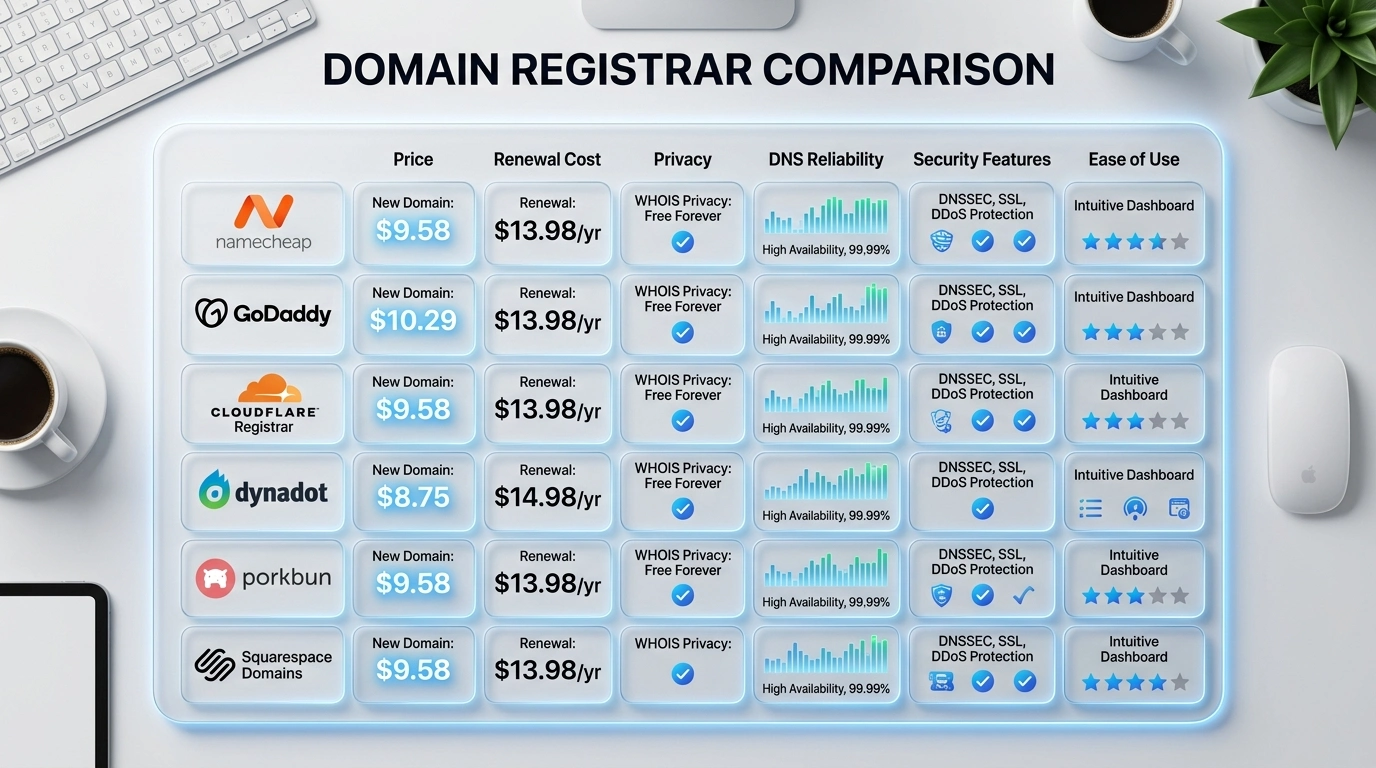
Namecheap vs Competitors (Detailed Comparison Table)
The following comparison highlights the factors most buyers care about when selecting a registrar.
Comparison Overview
Namecheap: Strong balance of affordability, privacy, usability, and flexibility.
GoDaddy: Extensive ecosystem but often higher ownership costs.
Cloudflare Registrar: Excellent for developers and infrastructure-focused users.
Dynadot: Strong value and portfolio management capabilities.
Porkbun: Competitive pricing and beginner-friendly experience.
Squarespace Domains: Convenient for users already using Squarespace.
Pricing Comparison Across Registrars
Many buyers focus only on first-year registration pricing. This is one of the most expensive mistakes domain owners make.
The real cost of ownership includes:
Initial registration.
Annual renewals.
Privacy protection fees.
Transfer costs.
Premium DNS add-ons.
Security upgrades.
When viewed across a three-to-five-year ownership period, pricing differences become much more significant.
Namecheap consistently ranks among the strongest overall values because many users receive privacy protection without additional recurring charges.
Porkbun often competes closely on price, while Dynadot also performs well in long-term cost comparisons.
GoDaddy can appear competitive initially but frequently becomes more expensive after promotional periods end.
Cloudflare operates differently, emphasizing near-wholesale pricing structures rather than marketing-driven discounts.
For cost-conscious entrepreneurs, the most important question is not "Which registrar is cheapest today?" but rather "Which registrar provides the best value over several years?"
Domain Privacy & Security Comparison
Domain ownership exposes valuable assets that require protection.
Security failures can result in:
Domain theft.
Website downtime.
Email disruption.
Brand damage.
Lost revenue.
Modern registrars should provide strong baseline protections.
Key Security Features to Look For
Two-factor authentication.
Registrar lock.
DNSSEC support.
Account monitoring.
WHOIS privacy protection.
Secure transfer controls.
Namecheap performs particularly well in privacy-focused comparisons due to its long-standing inclusion of free privacy protection on many extensions.
Cloudflare stands out for infrastructure security and DNS resilience.
Dynadot and Porkbun also maintain strong reputations among experienced users.
Security should never be treated as an optional upgrade. The cost of recovering a compromised domain often exceeds years of registration fees.

Ease of Use Comparison
Not every domain owner has technical experience.
A registrar should reduce complexity rather than create it.
Best for Beginners
Namecheap.
Porkbun.
Squarespace Domains.
These platforms generally provide straightforward interfaces, intuitive navigation, and easier onboarding experiences.
Best for Technical Users
Cloudflare Registrar.
Dynadot.
Namecheap.
These registrars offer more advanced DNS management capabilities while still remaining accessible.
Namecheap deserves special recognition because it successfully serves both audiences. Beginners can manage domains comfortably while advanced users still gain access to meaningful controls.
DNS Management & Developer Features
Developers often evaluate registrars through a different lens than business owners.
Rather than focusing primarily on pricing, they care about infrastructure flexibility.
Important Developer Considerations
DNS record management.
DNS propagation reliability.
API availability.
DNSSEC support.
Bulk management tools.
Automation capabilities.
Cloudflare remains one of the strongest options for developers due to its extensive infrastructure ecosystem.
Dynadot also appeals to advanced users managing larger portfolios.
Namecheap offers sufficient functionality for most startups, agencies, SaaS businesses, and growing projects without overwhelming less technical users.
The ideal registrar balances simplicity and power rather than forcing users to choose one or the other.
Which Domain Registrar Is Best for Beginners?
Most beginners want four things:
Affordable pricing.
Simple setup.
Privacy protection.
Reliable support.
For this audience, Namecheap consistently ranks among the strongest choices.
The dashboard is approachable, pricing is generally competitive, and privacy protection adds significant value.
Porkbun also performs extremely well for first-time buyers.
Squarespace Domains may appeal to users who plan to build their websites within the Squarespace ecosystem.
For most new website owners, Namecheap provides one of the best balances between simplicity, affordability, and long-term flexibility.
Which Is Best for Developers & Advanced Users?
Developers often prioritize infrastructure quality over marketing features.
Cloudflare Registrar stands out because of its DNS capabilities and integration with broader performance and security tools.
Dynadot also attracts experienced users who manage multiple domains and require advanced controls.
Namecheap remains highly competitive because it delivers enough technical functionality for most projects while maintaining a user-friendly experience.
Unless you require specialized infrastructure integrations, Namecheap often provides a better balance between convenience and capability.
Which Is Best for Cheap Domains?
Price-focused buyers should evaluate total ownership cost rather than introductory promotions.
Among the strongest value-focused registrars are:
Namecheap.
Porkbun.
Dynadot.
These providers frequently offer attractive combinations of registration pricing, renewals, privacy protection, and usability.
The lowest advertised price is not always the lowest long-term cost.
Smart buyers compare renewals, transfers, and included features before making a decision.
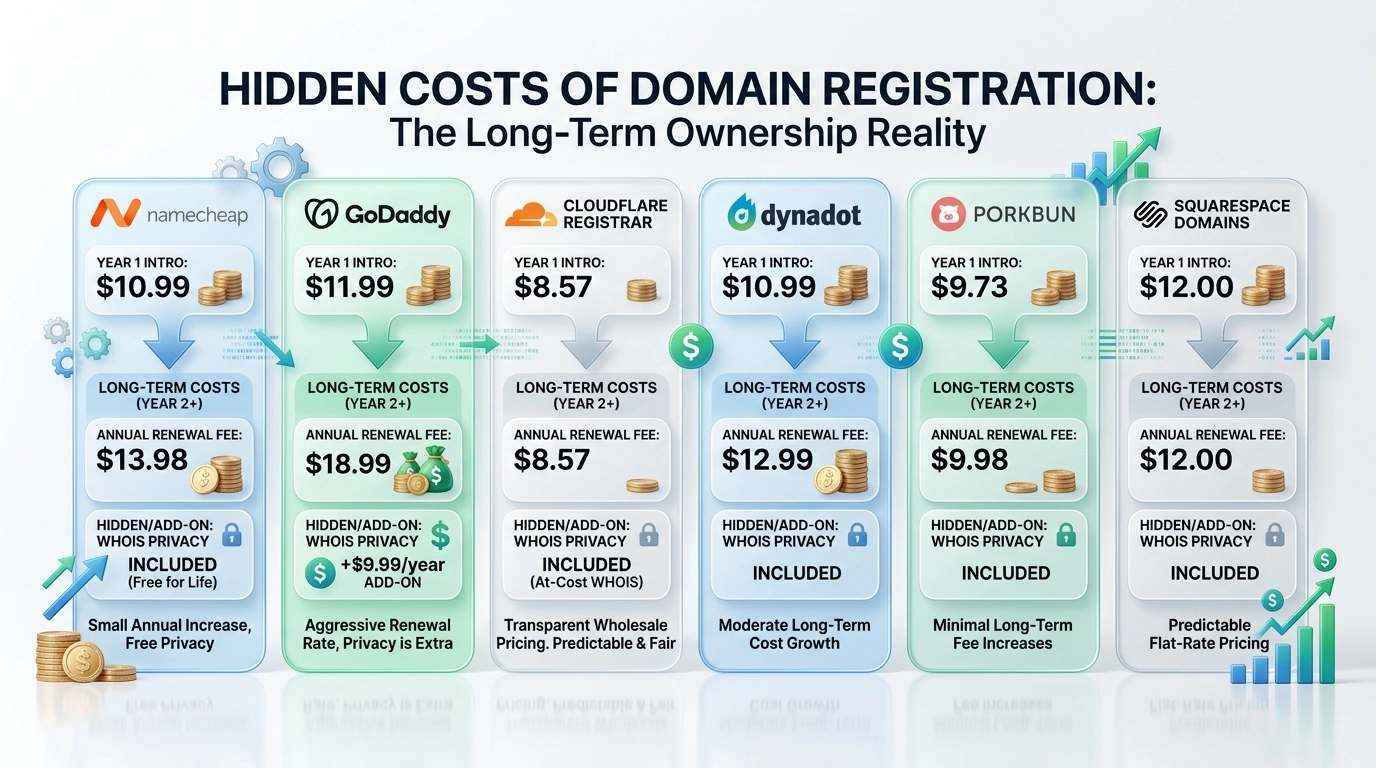
Hidden Costs Most Users Don't Notice
Many domain owners underestimate the impact of hidden costs.
Common examples include:
Higher renewal pricing.
Paid privacy protection.
Transfer fees.
Premium DNS upgrades.
Email add-ons.
Security upsells.
These charges can significantly increase total ownership expenses.
A registrar that appears slightly more expensive upfront may actually be the better value once hidden costs are considered.
This is one reason Namecheap continues to attract budget-conscious entrepreneurs and startups.
Migration Guide: How to Move Away from Google Domains
Moving away from Google Domains is typically straightforward when approached systematically.
Step 1: Review Current Domain Settings
Document DNS records, email configurations, subdomains, redirects, and security settings.
Step 2: Choose Your New Registrar
Select a registrar based on your priorities rather than defaulting to the first available option.
Step 3: Unlock the Domain
Ensure transfer locks are removed if a transfer is required.
Step 4: Obtain Authorization Codes
Retrieve transfer authorization information from the current registrar.
Step 5: Initiate Transfer
Follow transfer instructions provided by the new registrar.
Step 6: Verify DNS Settings
Confirm that websites, email services, and applications continue functioning correctly after migration.
Step 7: Enable Security Features
Activate two-factor authentication, registrar lock protections, and DNSSEC where appropriate.
Users seeking an affordable and beginner-friendly migration destination can explore Namecheap Domains through this link: https://namecheap.pxf.io/m4XPB1
Common Mistakes When Choosing a Domain Registrar
Choosing based solely on introductory pricing.
Ignoring renewal costs.
Overlooking privacy protection fees.
Failing to evaluate security features.
Ignoring support quality.
Not considering future scalability.
Selecting a registrar that is unnecessarily complex.
A domain often becomes a long-term business asset. Making decisions based purely on short-term discounts can create future frustration and expenses.
Expert Recommendation Framework (Decision Guide)
Use the following framework to identify the best registrar for your situation.
Choose Namecheap If:
You want strong overall value.
You prioritize affordability.
You want free privacy protection.
You need a beginner-friendly experience.
You run a blog, startup, ecommerce site, agency, or personal brand.
Choose Cloudflare If:
You are highly technical.
You prioritize infrastructure integration.
You actively manage DNS performance.
Choose Dynadot If:
You manage larger domain portfolios.
You want strong domain-focused tools.
Choose Porkbun If:
You prioritize value and simplicity.
You want transparent pricing.
Choose Squarespace Domains If:
You are heavily invested in the Squarespace ecosystem.
For the majority of entrepreneurs, bloggers, startups, and growing businesses, Namecheap remains one of the most balanced solutions available.
Final Verdict: Which One Should You Choose?
The best Google Domains alternative depends on your goals, technical requirements, and long-term ownership strategy.
Cloudflare excels for developers.
Dynadot appeals to experienced domain investors.
Porkbun delivers impressive value.
Squarespace Domains works well within its ecosystem.
GoDaddy offers scale and a broad service catalog.
However, when affordability, usability, privacy protection, flexibility, and overall value are considered together, Namecheap consistently emerges as one of the strongest choices in 2026.
It succeeds because it solves the problems most domain owners actually face. The platform remains accessible for beginners while providing enough functionality for serious projects.
For users seeking a reliable registrar after the Google Domains transition, Namecheap offers one of the clearest paths forward.
If you're ready to secure a new domain, compare extensions, or transfer an existing website, exploring Namecheap Domains is a logical next step.
Frequently Asked Questions
What is the best alternative to Google Domains in 2026?
Namecheap, Cloudflare Registrar, Dynadot, Porkbun, and Squarespace Domains are among the most popular alternatives. Namecheap is often recommended because of its combination of affordability, privacy protection, and usability.
Is Namecheap better than GoDaddy?
Many users prefer Namecheap because of its value proposition, free privacy protection on many domains, and generally simpler purchasing experience.
Which registrar has the cheapest domains?
The answer depends on registration fees, renewals, and included features. Namecheap, Porkbun, and Dynadot frequently rank among the strongest value options.
Is Cloudflare Registrar good for beginners?
Cloudflare is powerful but generally appeals more to technical users and developers than complete beginners.
Can I transfer my domain from Google Domains?
Yes. Domain transfers are common and typically straightforward when authorization codes and DNS settings are handled correctly.
Does WHOIS privacy matter?
Yes. Privacy protection helps reduce exposure of personal contact information and can minimize spam, unwanted solicitations, and privacy concerns.
How often should I review my registrar choice?
Most businesses should review registrar costs, features, and support quality annually to ensure they continue receiving strong value.
This Article was made with AI assistance and human editing.


